
The Org Chart For A One Person Business
I have 188 Claude skills built for my business. Six of them write my newsletters. Close to twenty run my events. There's one that classifies my expenses and one that tells me every morning what sold yesterday, and that one runs at 7:20 before I'm at my desk.
And until about a week ago I couldn't have told you what any of it added up to.
I think that's the real problem with AI right now for people running digital product businesses. It isn't that we don't have enough tools. It's that we have piles of them and no way to see whether the pile covers the business or leaves half of it uncovered. So you keep building more, and it keeps feeling like you're behind, and you can't say why.
So I drew an org chart.
Why an org chart, of all things.
An org chart in a normal company answers two questions. Who does this job, and who do they answer to. Nobody draws one for a business with one person in it, because the answer to both is obviously you.
That isn't true for me anymore. I have three contractors and 188 skills, and the answer to who does this job is now different for almost every job in the business. Some of them I still do by hand. Some get drafted and land back on my desk for me to finish. A few of them happen without me at all. And a handful, it turns out, weren't happening.
You can't see that from inside a to-do list. You can only see it when the jobs are laid out side by side with a name next to each one.
"I had 188 skills built and I couldn't have told you what they added up to."
The reason I drew the thingWhat the big companies figured out first.
When I went looking at how other people are doing this, almost everything written about it is aimed at companies with hundreds of employees, so not much of it is written for us. But a couple of conventions come up over and over and both of them changed how I drew mine.
The first is that the AI doesn't get a box of its own. The thinking is that a skill is a tool, so it doesn't take a headcount seat the way a person does. What goes on the chart instead is three things: the job itself, a named human who's accountable for the output, and who reviews it before it goes anywhere real. So the box says Email Marketing Manager, and underneath it says which skill does the drafting and who signs off.
The second is that there's a path every job walks and everybody uses the same one. It starts in co-pilot mode, where AI drafts and a human reviews and sends. Then you add a bar the work has to clear before it can go out on its own. Then, for the jobs that clear it reliably, it runs by itself and keeps a record of what it did. Support teams run that exact order before they'll let anything answer a customer without a person looking at it.
That second one is the one that applies to me. My whole marketing department is parked in co-pilot mode with no bar written down anywhere, which is why none of it ever comes off my desk.
The seven departments.
Here's the shape I landed on. Your business probably has the same seven, whatever you sell, and each one has four to six standing jobs in it.
Marketing is everything that goes out to people who haven't bought yet. Newsletters, blog, podcast, ads, and the person who decides what goes in each of them this week.
Sales is the pages and the sequences that turn readers into buyers. Sales pages, funnel emails, affiliates and partners, and somebody watching whether any of it works.
Events only exists if you run them, and if you do it's enormous. I run 24 a year across two brands, so this department has speaker sourcing, registration pages, attendee and speaker emails, graphics, the live day, and the debrief afterward.
Customer Success is everything after somebody pays. Support, member emails, community, course access, and keeping people from leaving.
Finance is bookkeeping, the revenue number, affiliate payouts, contracts, and disputes. This is the department everybody skips, mine included.
Operations is everything the rest of it runs on. Your reporting, your admin, your project tracking, and the writing down of how any of it works.
Product is what gets built, how it's structured, and what it costs.
A seat is one repeatable thing that has to come out, on a schedule, at a standard you'd recognize. "Writes the Sunday newsletter" is a seat. "Marketing" is a department. If you can't say what the job produces and how you'd know it came out right, it isn't a seat yet.
The four states every job is in.
This is the part that made the chart worth drawing. Once the jobs were listed, every single one landed in one of four states, and the four sit in a real order.
Nobody owns it
The work isn't happening. Sometimes that's a decision you made on purpose and sometimes it's a hole you didn't know was there, and you can't tell which until it's written on a chart in front of you.
Only you can do it
You do it by hand every time. Some of these should stay with you forever, like pricing and who you partner with. Most of them are habit rather than necessity.
It gets drafted and you finish it
AI does the first pass and it lands back on your desk. This is where most people's whole business lives, and it feels like progress right up until you notice you're still touching everything.
It runs without you
It happens on a schedule, you see the result, and you only step in when something looks wrong. My four morning reports live here and they're the only reason my day starts with information instead of a blank page.
There's a fifth state, and it sits off to the side of that ladder rather than on it. Somebody does the job, and nobody ever wrote down how. It looks like state three or four on a normal week. It falls apart the week that person is out, and it's also the thing that makes a business hard to sell.
What I actually found.
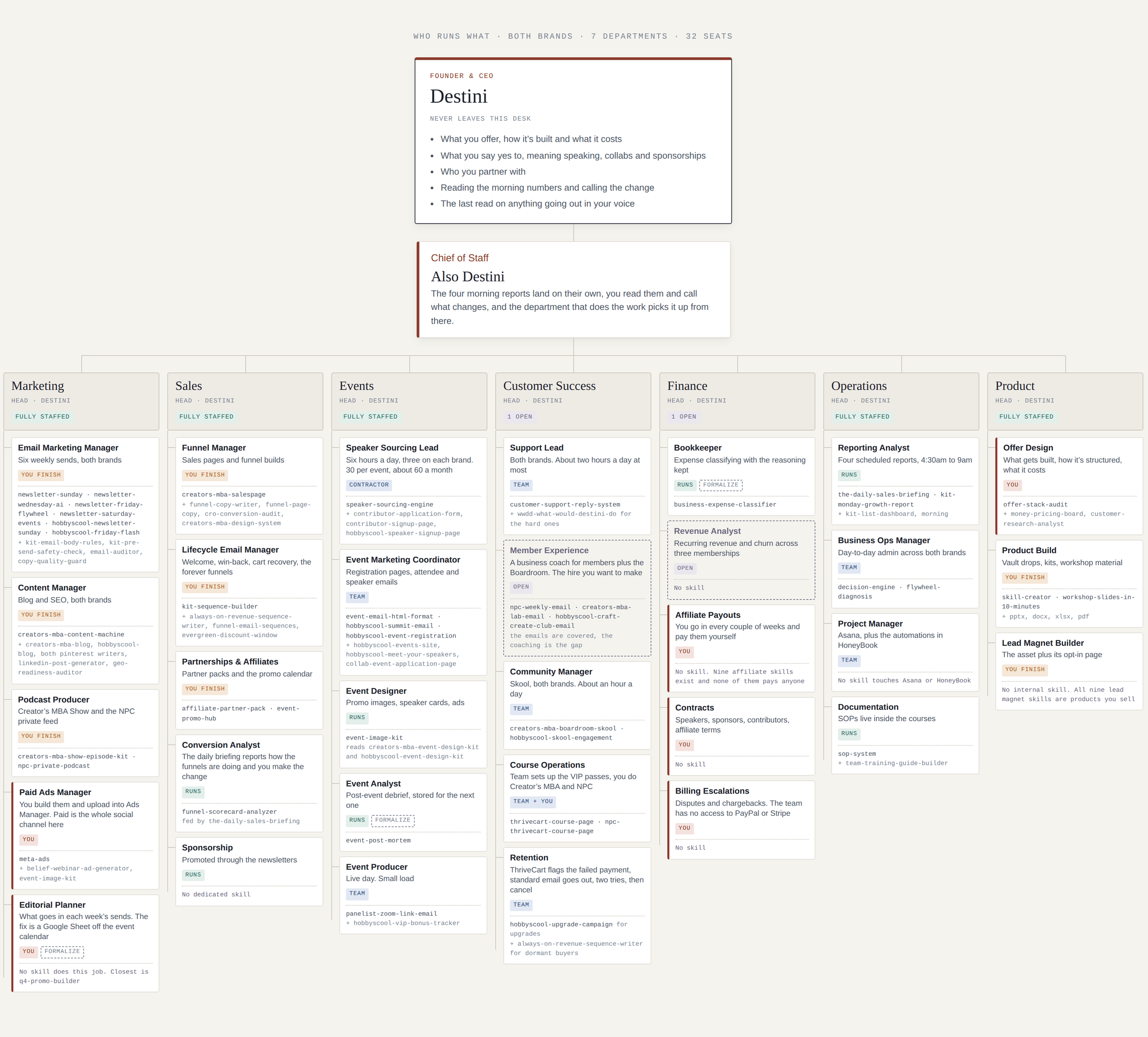
Thirty-two seats across the seven departments. Here's where they landed.
The first thing is that only two seats were genuinely empty, and I'd have guessed a dozen. Most of what felt like a hole already had somebody in it, and what was missing was a written process rather than a person.
The second thing is where the coverage clusters. Marketing, Events and Customer Success are deep, with a skill for every send, every brand, every membership. Finance has one staffed seat out of five. The four bare ones are the four I do by hand, which are the payouts, the contracts, the disputes, and the recurring revenue number I don't have. Only one of those four has a real reason behind it, which is that my team can't have access to my payment accounts.
The third thing is the one I keep thinking about. Two of my seats are surrounded by skills, and every one of those skills was built for somebody else. I have nine skills that build lead magnets. Every one of them was built for my students to use, and none of them is pointed at my own business.
Count your seats before you build another skill.
Most of us solve the overwhelm by adding. Write out the jobs first, put a name next to each one, and you'll usually find you already own four tools for the same job and nothing at all for the one that's actually costing you money.
Why this feels so hard right now.
Here's the thing about how we've all been buying and building AI tools. We collect them by capability. This one writes emails, that one makes images, this other one does research. Capability is an easy way to shop, and it tells you nothing about whether the work is getting done.
A company doesn't have this problem, because a company hires against a job. You don't hire a person who's good at spreadsheets. You hire a bookkeeper, the bookkeeper closes the month, and if the month doesn't close you know whose job that was.
That's what an org chart does for a business with one person in it. It makes you say the job out loud before you go looking for the thing that does it, and once you say the job out loud you find out fast whether it's covered, half covered, or not covered at all.
The overwhelm is coming from not being able to see the work. Thirty-two boxes on a page fixed that for me in an afternoon.
How to draw yours this week.
This takes about an hour and you don't need anything fancy to do it.
- Write the seven departments down the page. Skip the ones you don't have, and most people won't have Events.
- Under each one, list the standing jobs. The test is that it produces something on a schedule. Four to six per department is plenty.
- Put a name next to every job. You, a person on your team, or the specific tool or skill that does it.
- Mark each one with its state. Nobody, only you, drafted and you finish, or runs without you.
- Circle anything where somebody does the work and nothing is written down.
Then look at the page and count. If your empty seats are all in one department, that's your next project. If most of your business is in state three, your next project is writing down what good enough to send means, so things can start moving up. And if you've got four tools fighting over one seat, what you need is a cleanup.
Not sure which part of your business is the weak link?
The Creator Business Scorecard walks you through the five stages of your flywheel in about two minutes and tells you where the gap is.
Take the free scorecard →Frequently asked.
How do I structure a one person business that uses AI?
Draw the departments a business that size actually has, which for most digital product businesses is marketing, sales, events, customer success, finance, operations and product. Then list the standing jobs inside each one, and put a name next to every job. The name can be you, a contractor, or a specific AI skill. Any job with no name is an open seat.
Should AI agents get their own box on an org chart?
The common convention is no. An AI skill is a tool rather than a person, so it doesn't take a headcount box. What goes on the chart is the job, a named human who owns the output, and who reviews the work before it goes anywhere real. Three things per seat, and no reporting line for the software.
What are the four states a job in my business can be in?
Nobody owns it, only you can do it, it gets drafted and you finish it, or it runs without you. Those four sit in order, and the work of building a business that doesn't need you every day is moving jobs from the first state toward the last one on purpose.
How many AI skills do I need to run a digital product business?
Fewer than you think, and the number matters less than the coverage. Twelve skills that each own a standing job beats eighty that overlap. Count seats first, then count skills against them, and you'll usually find you already own more than you need in some departments and nothing at all in others.
What's the difference between an empty seat and one that isn't written down?
An empty seat means the work isn't happening. A seat that isn't written down means the work happens because one person remembers to do it. The second one looks fine on a normal week and falls apart the week that person is out, and it's also what makes a business hard to sell.

Dr. Destini Copp helps digital product creators build sustainable, systems-based businesses through the Creator Growth Flywheel framework. She's the founder of Creator's MBA and HobbyScool, and has been teaching online business strategy for over a decade. Learn more →