
How I Built a $37 Tripwire Funnel in an Afternoon Using AI
Here's the thing about a free lead magnet. It grows your list, but it doesn't grow your bank account. Someone downloads your freebie, lands on a thank-you page that says "check your inbox," and then nothing happens. They go cold before they ever spend a dollar with you.
I had that exact gap in my own business. A free calculator that brought people in, and a dead thank-you page that sent them nowhere. So this week I fixed it. I built a tripwire funnel that turns a free lead into a $37 buyer in the first five minutes, and I did the whole thing in an afternoon with AI handling most of the building.
This is the full walkthrough. Every page, every offer, and how the pieces connect. If you have a freebie that grows your list but never makes a sale, this is the fix.
First, what a tripwire funnel actually is
A tripwire funnel is a small, low-priced offer that you put in front of a new subscriber right after they opt in. The price usually sits somewhere between $7 and $47, low enough to be an easy yes for someone who just met you.
The point isn't the $37 itself, it's the shift it creates. The moment someone buys from you once, even something small, they stop being a name on a list and become a customer. And a customer is far more likely to buy from you again than a free subscriber who has never spent a dime.
In the Creator Growth Flywheel, this is the move that carries people out of the Attract stage, where you're just growing an audience, and into a real buying relationship. It's the difference between a list that looks big and a list that pays you.
"A free subscriber costs you money to keep, but a $37 buyer starts paying you back the same day."
— Dr. Destini CoppThe seven pieces of the funnel I built
Every tripwire funnel has the same bones. Once you see the parts, you can build your own version. Here's what I put together, in the order a new lead moves through it.
The front door — a free calculator
The lead magnet that brings people in. They enter a name and email to get their result.
The bridge — a redirect, not a dead end
Instead of a "check your inbox" page, the opt-in sends people straight to the offer.
The $37 offer — the tripwire itself
A small, genuinely useful product that solves one problem fast.
The $17 order bump
A one-click add-on at checkout that raises the average order value.
The upsell and downsell
The path to the real destination: the membership, at lifetime or monthly.
The delivery
A simple course that hands the buyer exactly what they paid for.
The follow-up — two sequences, not one
One set of emails for leads who haven't bought, another for the people who did.
Now let's walk through each one the way I actually built it.
Piece 1: The front door
My lead magnet is a calculator. Someone enters their name and email, and they get a personalized number back. A calculator makes a strong front door because it's interactive, and the result is specific to the person, so the offer that comes next feels relevant instead of random.

Piece 2: The bridge (the part most people skip)
This is where most funnels leak, and it's the piece I'm proudest of fixing. The standard setup sends a new subscriber to a thank-you page that says "check your inbox" and stops there, and that page is a dead end, because the lead is as warm as they'll ever be and you've just sent them nowhere.
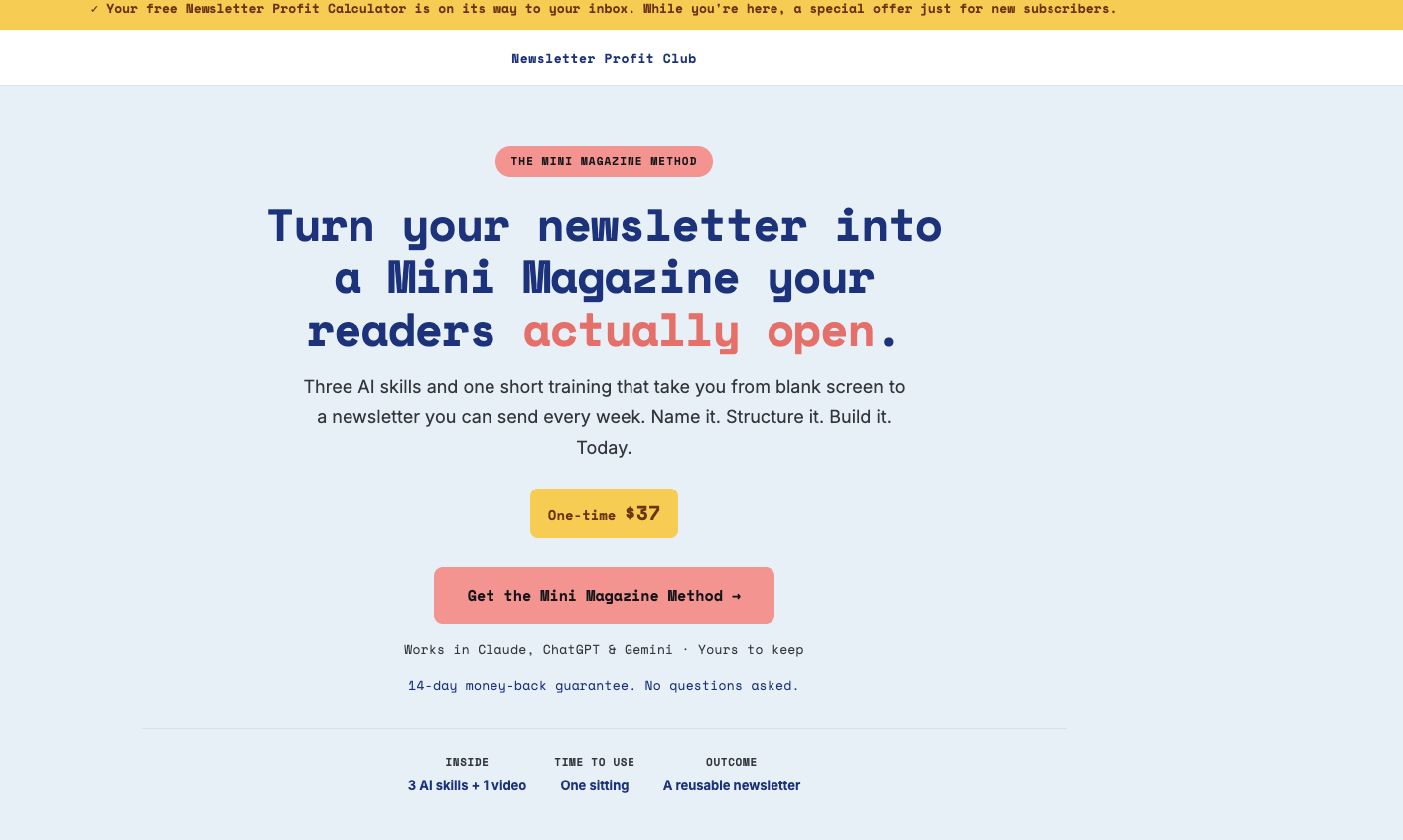
So I changed it. The second someone opts in for the calculator, they now redirect straight to the sales page for the $37 offer. The top of that page tells them their free gift is on its way to their inbox, and here's a special offer while they're here. That one change turns a dead thank-you page into a bridge that carries a warm lead right into a real offer.
I'm also testing a 20-minute timer on the page, so the offer has an honest reason to act now instead of "later," which usually means never.
Piece 3: The $37 offer
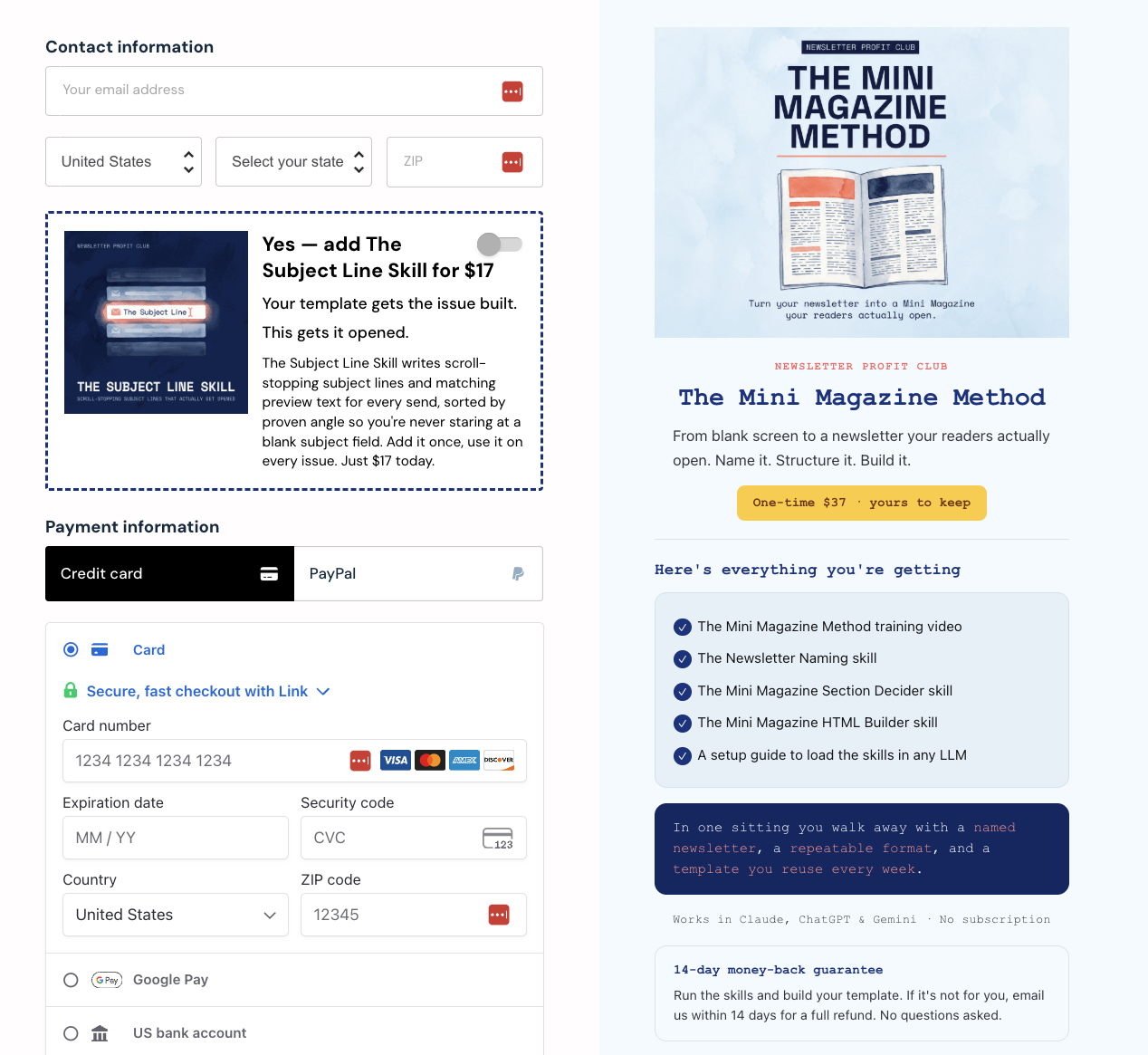
The tripwire itself is my Mini Magazine Method, priced at $37. It teaches the exact format I use to structure a newsletter people actually open and read.
I picked this offer on purpose. It solves one real problem fast, it's genuinely useful on its own, and it sets up the next step without giving everything away. That last part matters more than it sounds, and I'll come back to it when we get to the emails.
Piece 4: The $17 order bump
Right on the checkout page, I added a $17 order bump for my Subject Line Skill. An order bump is a small add-on offer with a checkbox, sitting on the same page where they're already buying. It raises the average order value without adding a single new step to the funnel.
The trick with a good bump is that it has to be the obvious next thing. Someone buying a newsletter format is the exact person who also wants help writing subject lines that get opened, so checking that box is an easy yes.

Piece 5: The upsell and downsell
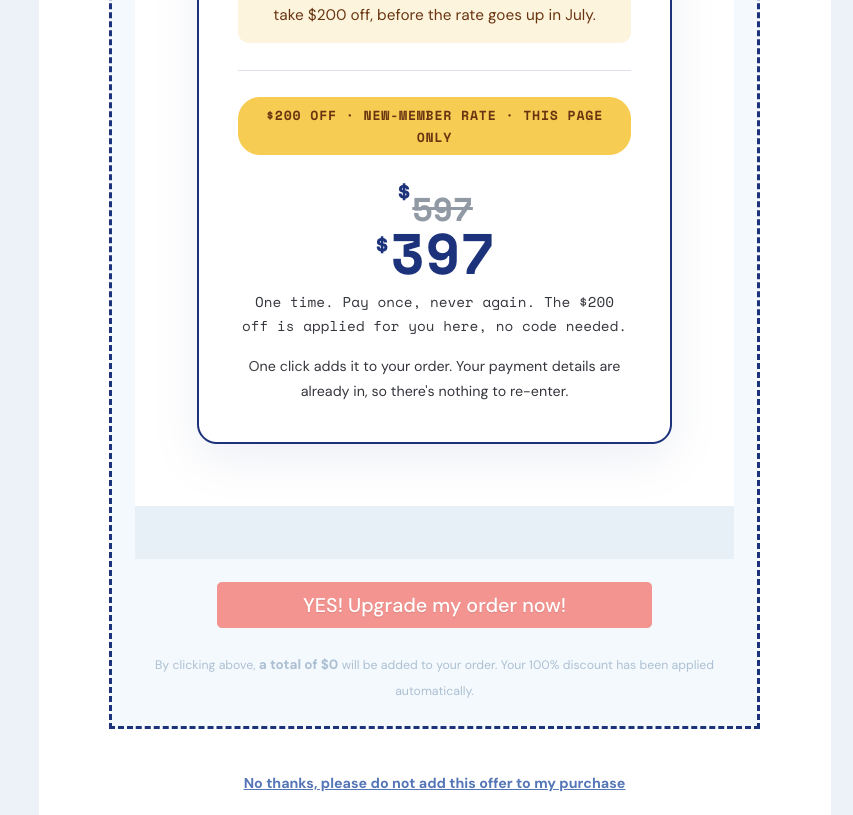
After the $37 purchase, the funnel offers the real destination: lifetime access to Newsletter Profit Club at $397. If they say no, they see a downsell of the same membership at $29 a month.
This is the ascension path, and it's the whole reason the $37 exists. The tripwire is the front door. The membership is where the relationship actually goes. The small purchase just makes the bigger one feel like a natural next step instead of a cold pitch.

Piece 6: The delivery
A funnel isn't done when someone buys. They have to actually get the thing, and the experience right after purchase is where a lot of buyers quietly lose trust. So I built the delivery as a short, clean course with three lessons.
The first is a START HERE lesson with a welcome video and the four steps to follow, so nobody lands and wonders what to do. The second is a setup guide. The third is a skills lesson with copy-paste boxes, so buyers can grab what they need in one click instead of hunting for it. Support points to my free community instead of an inbox, which keeps the whole thing scalable as more people come through.

Piece 7: The follow-up (two sequences, not one)
The emails are where the funnel keeps working after the sale, and this is the part people get wrong most often. They try to make one sequence do everything. I built two, because two different people need two different messages.
The first sequence is for calculator leads who haven't bought yet. It delivers the calculator, points them to their number, and bridges to the $37 offer. Anyone who doesn't buy gets handed to my free training instead. This sequence is set to skip people who already bought and people who are already members, so nobody gets pitched something they own.
The second sequence is for the people who bought the $37. It welcomes them, gives them a few days to actually use what they got, and then bridges to the membership. Here's the piece I planned on purpose: the $37 teaches the format, but it holds back the Teach and Pitch Method, which is how you turn that format into actual sales. That held-back piece is the honest, obvious reason to join the membership. The value they already got is real, and the next step is clear.
You deliver something genuinely complete at $37, but you hold back the one piece that makes it pay, and that gap becomes your honest bridge to the bigger offer. It never feels like a bait and switch, because what they already bought works on its own.
The part that actually changed: speed
Here's what I want you to notice: none of this is new funnel theory. Tripwire funnels have worked for years. What changed is how fast you can build one.
AI drafted the sales page copy, built the lesson pages, and wrote the first pass of both email sequences, and I edited everything for my voice and my judgment. Even the product and course cover images came from prompts I wrote in Gamma, so I never opened a design tool or hired anyone to make them. The blank-page part, the part that used to eat a whole week, was just gone, so I went from idea to a live funnel in an afternoon.
That's the real shift for creators right now. The building is cheap now, so the thinking is what's worth your time. Deciding what to hold back, which offer goes where, and who gets which email is the part only you can do, and it's the part that makes the whole thing work.
Where to start if your funnel is leaking
If you've got traffic coming in but no sales coming out, the leak is almost always in one of these seven pieces. Usually it's the bridge, that dead thank-you page sending warm leads nowhere, so start there first and then work through the rest one piece at a time.
Not sure where your funnel is leaking?
Take the free 2-minute Creator Business Scorecard and find the exact stage that's costing you sales right now.
Take the Free Scorecard →Frequently Asked Questions
A tripwire funnel is a low-priced offer, usually $7 to $47, that you put in front of a new subscriber right after they opt in. The goal is not the small price. It's turning a free subscriber into a paying customer, because someone who has bought from you once is far more likely to buy again.
Most tripwire offers sit between $7 and $47. The price needs to be low enough to be an easy, low-risk yes for someone who just met you, but high enough that the buyer is a real customer and not just a freebie collector. I priced mine at $37.
It helps. A free lead magnet, like a calculator or a guide, is the front door that brings people in. The tripwire is what you show them right after they opt in. You can also send warm or paid traffic straight to the tripwire sales page if you want to skip the freebie step.
You need a checkout tool that supports order bumps and upsells, an email platform to run the follow-up sequences, and a landing page tool for the opt-in and sales pages. I used ThriveCart for the cart and course delivery, Kit for email, and an HTML landing page builder for the pages.
A regular funnel often sells one main offer over time. A tripwire funnel leads with a small, fast yes to convert a free lead into a buyer in the first few minutes, then uses an upsell and follow-up emails to move that new buyer toward your bigger offer.