

The New Buyer You're Not Optimizing For
You've spent years optimizing your product pages for human buyers. You've tweaked your titles, dialed in your descriptions, stacked up reviews. And it's working — to a degree.
But here's what's changing fast: the buyer isn't always a human anymore.
AI shopping agents — tools like ChatGPT's Agent Mode, Google's "Buy for Me," and Amazon's Rufus — are already live or rolling out to mainstream users. These agents don't browse. They evaluate, decide, and purchase on behalf of whoever prompted them. And they have their own biases about what to pick.
New research from Columbia and Yale universities studied exactly how these agents make buying decisions. The findings are fascinating — and genuinely useful for any digital creator who sells products online, whether you're running a Shopify store, an Etsy shop, or a course platform.
This Is a Legitimately New Problem
Most people assume AI agents are just faster search engines. They're not. A search engine surfaces options and lets the human decide. An AI agent eliminates most of the options and makes the decision itself.
That's a meaningful shift in how discoverability works. You're no longer just competing for a human's attention in a list of results. You're competing for an algorithm's selection — and that algorithm has preferences you may not have thought about yet.
"We've spent years optimizing for humans. Now we need to optimize for the agents buying on their behalf — and they don't think exactly like us."
— Dr. Destini Copp, Creator's MBAThe researchers tested thousands of buying scenarios across eight product categories, using major AI models including ChatGPT, Gemini, and Claude. What they found gives us a real starting framework for how to think about this.
What the Research Actually Found
The Columbia/Yale study identified several factors that consistently influence whether an AI agent selects a given product. Some of these will feel familiar. Others might surprise you.
1. Keywords in Your Product Title Matter — A Lot
The biggest takeaway from this research is how sensitive AI agents are to the specific words — and word order — in a product title.
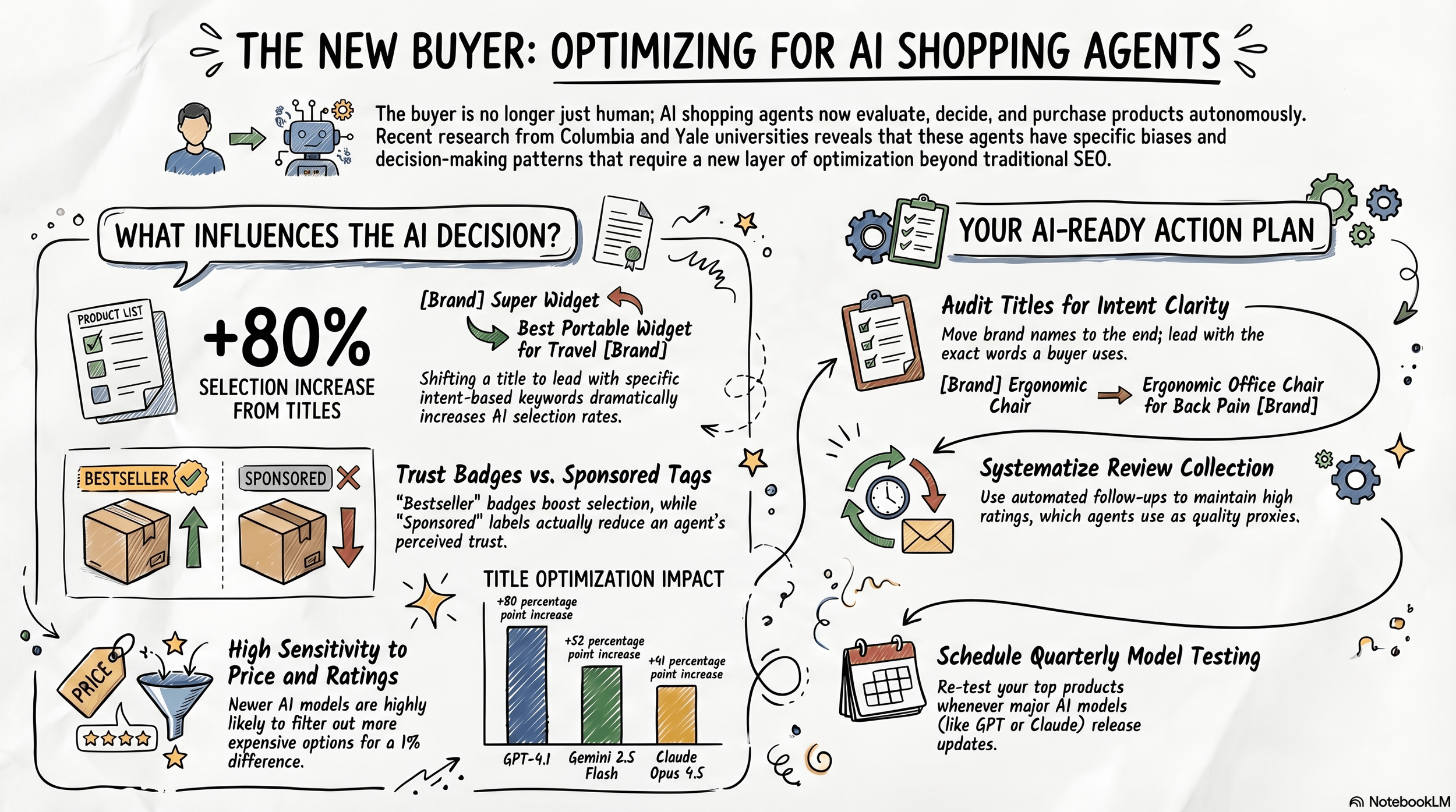
In one experiment, the researchers changed a product listing from "SUNMORY Floor Lamps for Living Room" to "SUNMORY Office Floor Lamp." That single title change led to an 80 percentage point increase in how often GPT-4.1 selected that product when a buyer asked for an office lamp.
The lesson: your product title needs to lead with what the buyer is actually searching for, not what sounds clever or brand-forward. If someone asks an AI agent to find a "social media template bundle," your listing titled "The Content Creator Kit" might not even register — even if it's exactly what they need.
2. Reviews and Ratings Still Signal Trust
AI agents are trained on human decision-making patterns, and humans use reviews as a proxy for quality. Agents carry that same bias. The research found that a 0.1 increase in ratings measurably raises the likelihood of a product being selected.
This means the basics still matter. Collecting reviews consistently, maintaining strong ratings, and responding to feedback all feed into how AI agents perceive the credibility of your product — not just how humans do.
3. Trust Badges Work — But "Sponsored" Backfires
Badges like "Bestseller," "Recommended," or "Our Pick" positively influence AI agent selection. These labels function as social proof signals that agents are tuned to recognize.
On the flip side, "Sponsored" labeling reduces a product's chances of being chosen. AI agents appear to be trained to treat sponsored placements as less organically trustworthy. Worth keeping in mind if you're running paid placements on marketplaces — they may help with human visibility but hurt with agent selection.
4. Competitive Pricing Still Signals Value
When the researchers tested two identical products — one priced 1% lower than the other — the failure rate of newer AI models choosing the more expensive option dropped dramatically. Older models got it wrong fairly often. Newer models almost never did.
This doesn't mean you need to race to the bottom on price. But it does mean that if you're selling a comparably positioned product at a significantly higher price point without a clear differentiator in your listing, you may be getting filtered out before a human even sees you.
Each AI model weighs these factors differently — and those weights change with every major model update. This isn't a one-time fix. It's an ongoing optimization practice, similar to SEO.
What This Means for Digital Product Creators Specifically
Most of the examples in the research are physical product-focused — lamps, housewares, that kind of thing. But the principles translate directly to what we sell.
Think about how someone might use an AI agent to find a digital product. They might say: "Find me a Canva social media template pack for a wellness coach" or "Buy me a course on email list building for beginners." The agent is going to scan listings, reviews, and trust signals — and pick.
If your Shopify product is titled something like "The Brand Builder Bundle" with a vague description, you're essentially invisible to that query. But if it's titled "Canva Social Media Templates for Wellness Coaches — 30 Customizable Designs," you're speaking the language an agent understands.
Where to Start: A Practical Audit
Audit Your Product Titles for Intent Clarity
Read each product title as if you're an AI agent processing a customer query. Does the title contain the exact words a buyer would use? Is the primary use case in the first few words? Brand names and clever labels should come after the descriptive keywords — not before.
Make Review Collection a System, Not an Afterthought
If you're not actively requesting reviews post-purchase, you're leaving trust signals on the table — for both humans and agents. Build a simple follow-up sequence for every product that invites buyers to leave a review within 7 days of purchase.
Identify Which AI Agents Your Buyers Are Using
Not all AI agents weight the same factors. If your audience skews toward ChatGPT users, GPT's selection criteria should inform your optimization. If they're Gemini users, the weighting is different. Survey your audience or make educated guesses based on where they hang out — and test accordingly.
Use Platform Trust Badges Where Available
If your platform supports trust indicators — bestseller flags, verified purchase badges, featured product labels — use them. These are signals that AI agents are tuned to notice. On platforms where you control the label, consider language like "Most Popular" or "Instructor Recommended" in your product copy.
Revisit Optimization After Major AI Model Updates
This is the piece most people will skip — and it's where you'll gain a real edge. The research shows that decision-making logic can shift significantly between model versions. Build a quarterly reminder to test your top products against major AI agents when new model versions drop.
The Bigger Picture: Adding a New Layer to Your Attract Strategy
In the Creator Growth Flywheel, the Attract stage is all about being discoverable to the right people at the right time. For years, that meant SEO, social media, and podcast appearances. Then it expanded to include AI search optimization — making sure your content surfaced in tools like Perplexity, ChatGPT search, and Google's AI overviews.
AI agent optimization is the next layer. It's not replacing what you already do. It's adding a new surface where buyers might find you — or miss you entirely.
Most people assume this is a future problem. It's not. These agents are live now, rolling out to mainstream users across the major AI platforms. The creators who start optimizing their product listings for agent discovery today will have a compounding advantage over the next 12 months as agent-based shopping becomes normal behavior.
Here's the thing about compounding advantages: they don't feel significant in the moment. But six months from now, when a buyer asks ChatGPT to find a digital planner for a creative entrepreneur and your product shows up — and your competitor's doesn't — you'll be glad you spent an afternoon on your titles.
The Bottom Line
AI agents are introducing a new buyer into the equation — one that doesn't browse, doesn't click around, and doesn't respond to clever branding the way humans do. It responds to clarity, credibility signals, and keywords that match intent.
The good news: the fundamentals of great product listing copy haven't changed. Clear, specific titles. Strong reviews. Trust signals. Competitive positioning. What's changed is the stakes — and the fact that an algorithm is now making the final call before a human ever sees your product.
Start with your titles. One small shift — leading with what your product actually does and who it's for — could meaningfully change how often AI agents put you in front of buyers.
Is Your Creator Business Built to Be Found?
Take the free Creator Business Scorecard and get a personalized breakdown of where your business stands across all five stages of the Creator Growth Flywheel.
Take the Free Scorecard →The data in this article comes from What is your AI Agent Buying? Evaluation, Biases, Model Dependence and Emerging Applications for Agentic E-Commerce — a working paper by Allouah, Besbes, Figueroa, Kanoria, and Kumar (Columbia University & Yale University, December 2025). Note: this paper has not yet been peer-reviewed and findings may be updated as research continues.
Frequently Asked Questions
Research from Columbia and Yale shows that AI agents weigh factors including keyword placement in product titles, number of reviews, product ratings, trust badges (like "Bestseller" or "Recommended"), and competitive pricing. The specific weight given to each factor varies across different AI models — ChatGPT, Gemini, and Claude each behave differently.
Yes — dramatically. In one study, changing a product title from "Floor Lamps for Living Room" to "Office Floor Lamp" led to an 80 percentage point increase in selection by GPT-4.1. The keyword order and specificity in your title matter more than most creators realize.
Yes. Whether you sell digital downloads, courses, or templates, the same principles apply: use specific, intent-matching keywords in your titles, accumulate reviews, maintain strong ratings, and use trust badges where your platform supports them. This is becoming a new layer of product discoverability.
Labeling a product as "Sponsored" actually reduces its chances of being chosen by AI agents, according to the Columbia/Yale research. AI agents appear to be trained to deprioritize sponsored results in favor of what seems to be the most genuinely relevant match.
Researchers recommend revisiting your optimization each time major AI models release updates, because the factors agents consider — and the weight given to each — can shift significantly between versions. What worked for GPT-4o may not work the same way for GPT-5.1.