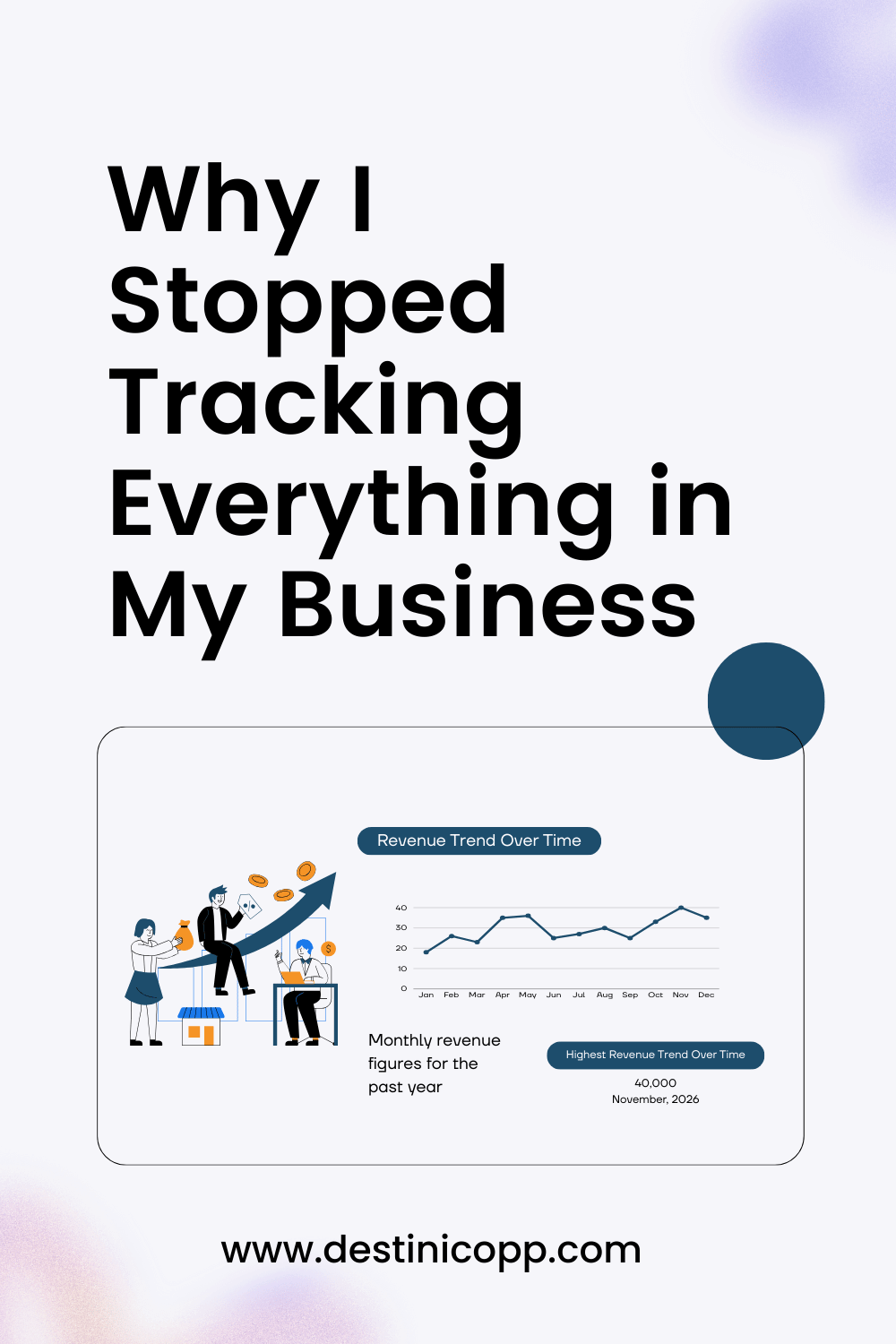

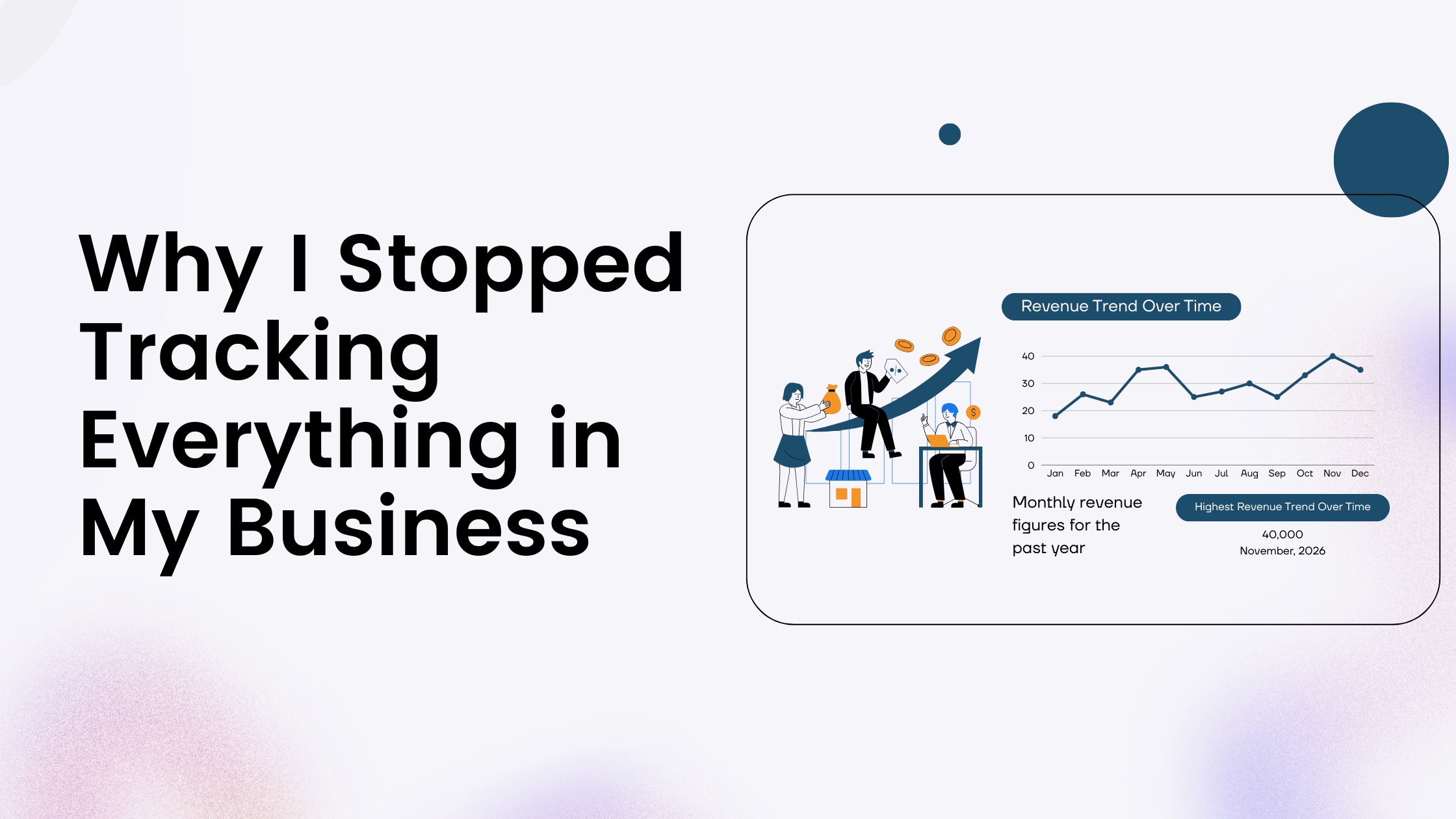
Why I Stopped Tracking Everything in My Business
For a long time, I thought being a good business owner meant tracking more.
More metrics. More dashboards. More spreadsheets. More numbers, just in case.
If something felt off in my business, my first move wasn't to decide. It was to go look for more data. So I tracked everything. Revenue by product. Every funnel. Open rates and click rates. Time spent, energy spent, tools used. It looked responsible. It felt like the thing a serious CEO would do.
It wasn't making my business any easier to run.
Tracking Didn't Give Me Clarity. It Delayed Decisions.
Here's the thing. The problem was never accuracy. My numbers were fine.
The problem was usefulness. I could see a lot. I just couldn't decide any faster.
Every review turned into the same loop. Something was up. Something was down. And everything felt like it needed my attention right now. Instead of clarity, I stayed stuck in analysis mode. Tracking made me informed. It did not make me decisive.
And when you run a small business, decisive is the whole game. You don't win by staring at the dashboard longer than everyone else. You win by making good calls and moving on. The dashboard was quietly training me to do the opposite.
Why Most Creators Over-Track
Let's be honest about what's really going on here.
Creators don't track everything because they love data. They track everything because they don't want to make the wrong call.
More data feels safer than choosing. More metrics feel smarter than committing. More tracking feels like progress, even when nothing actually changes in the business.
At some point I had to say the quiet part out loud. I wasn't tracking to lead better. I was tracking to avoid being responsible for the decision.
That's the trap. A full dashboard can look like diligence when it's really just delay. You tell yourself you'll decide once you have enough information. But there's always one more number to check. One more week of data to wait for. The "enough" never comes, because certainty was never really the point. Staying busy was.
When you catch yourself pulling one more report before you'll commit to a decision, that's usually not research. That's avoidance wearing a spreadsheet.
Leadership Doesn't Happen Inside Dashboards
Here's the shift that changed how I run things.
Leadership does not happen in real time. It happens in review cycles.
Dashboards are built for monitoring. But you, the CEO, are responsible for decisions. Those are two different jobs, and I'd been trying to do the second one with a tool built for the first.
When you're watching everything all the time, a few things happen. You react instead of lead. You optimize things that don't matter. And you confuse activity with progress. I didn't need more visibility. I needed a set moment to step back and actually decide.
Think about it like driving. You don't rebuild the engine while you're doing 70 on the highway. You watch the road, you get where you're going, and you deal with the engine back in the garage. Trying to make big business calls while staring at live numbers is the same mistake. Wrong time, wrong place.
"Dashboards are built for monitoring. CEOs are responsible for decisions."
— Dr. Destini Copp, Creator's MBAI Didn't Stop Tracking. I Stopped Tracking Everything.
This is where people get me wrong, so let me be clear.
I didn't stop using numbers. I didn't switch to going with my gut. I didn't decide metrics don't matter. I stopped treating my business like something that needed me watching it every minute.
Instead, I moved to intentional reviews. Monthly. Focused. Built around decisions, not just observation. The question stopped being "what changed?" And it became three better ones.
The Monthly CEO Review
This is the whole system. Three questions, once a month. Here's what each one is really asking.
What Worked?
Not "what went up." What actually worked. Which offer brought in real revenue. Which piece of content pulled in the right people. Which effort paid off. You're looking for the wins worth repeating, not every green arrow on a chart.
What Cost More Than It Should Have?
This is the money question and the energy question at once. Which offer took a mountain of effort for a small return. Which tool you're paying for and barely using. Which project drained you and gave little back. This is where you find what to cut.
What Deserves My Attention Next?
Out of everything in front of you, what would actually move the business forward if you committed to it? Not what's easiest. Not what's loudest. What matters most for the next 30 days.
That's it. You don't need a live dashboard to answer those. You need one honest hour a month.
This Is Also a Flywheel Review
Here's where it ties into how I think about growth.
I run my business on the Creator Growth Flywheel. It's five stages that feed each other: Attract, Engage, Nurture, Retain, and Advocate. Attract is how new people find you. Engage is how they interact with your stuff. Nurture is how you build trust over time. Retain is how you keep the buyers you already have. And Advocate is how happy customers bring you new ones.
When I sit down for my monthly review, I'm really asking those three questions about each stage. Is one stage doing the heavy lifting? Is one quietly leaking? You don't need a real-time chart to feel where the wheel is dragging. You need one focused look, once a month, and the honesty to name it.
That's the difference between watching the flywheel spin and actually turning it.
Fewer Metrics. Better Questions.
The biggest improvement wasn't fewer numbers. It was better questions.
Instead of "what's the conversion rate doing?" I ask, "is this offer still worth my time and energy?"
Instead of "why did this dip?" I ask, "do I want to keep this going, or is it time to stop?"
Instead of "what should I optimize?" I ask, "what would actually move the business forward if I committed to it?"
Those are leadership questions. They don't need a dashboard. They need a decision.
Simplicity Is Not Laziness. It's Experience.
There's a stage where tracking everything makes sense. You're new. You're testing. You're still figuring out how your business actually works. Watch everything for a while. That's smart.
But staying there forever isn't discipline. It's avoidance.
Experienced leaders simplify on purpose, because they've learned a few things. Not everything deserves attention. Not everything needs to be measured. And not every dip requires action. Simplicity isn't about doing less. It's about choosing what matters on purpose.
What Changed When I Let Go
Once I stopped tracking everything, the business got easier to run.
Reviews got shorter. Decisions got clearer. Patterns were easier to spot, because I wasn't buried under noise. And the whole thing felt lighter to lead.
I wasn't reacting to data anymore. I was using it to make calls. That's the difference, and it's a big one.
The Actual Job of a CEO
Your job as a CEO is not to know everything. It's to decide. What matters right now. What continues. What stops. And what gets your focus next.
Tracking supports that job. It does not replace it. Once that clicked for me, I stopped trying to see everything and started running my business like a CEO again.
If you feel buried in your own dashboards right now, you don't need more numbers. You need one focused hour a month and three good questions. Start there.
Want to See What's Actually Working in Your Business?
Skip the dashboard overwhelm. The Creator Growth Flywheel Scorecard shows you which stage of your business is strong, which one is quietly leaking, and where to put your focus next. It's built for decisions, not monitoring.
Take the Free Scorecard →Frequently Asked Questions
For most creators, once a month is plenty. A focused monthly review gives you enough time to see real patterns without reacting to every daily bump. Watching numbers all the time tends to create noise, not clarity. A set monthly moment to step back and decide is what actually moves the business.
The ones tied to decisions you can act on. Revenue by offer, what each offer costs you in time and energy, and where new buyers are coming from will carry most of the weight. If a number does not change a decision, it is probably safe to stop watching it so closely.
It feels responsible, but often it is avoidance in disguise. Collecting more data can be a way to delay a hard call. When you are new and still learning how your business works, tracking a lot makes sense. Staying there forever usually means you are avoiding the decision, not preparing for it.
Three questions cover most of it. What worked and is worth repeating? What cost more than it should have in time, money, or energy? And what deserves my attention next? These are leadership questions. They point you toward a decision instead of another spreadsheet.
Move from constant monitoring to a set review cycle. Pick one hour a month, ask a short list of decision-focused questions, make your calls, and close the tab. The goal is not to see everything. It is to decide what matters, what continues, what stops, and what gets your focus next.