
How I Turned a Printable Craft Planner Into a No-Code App for My Membership
This post contains an affiliate link. If you sign up through it, I may earn a commission at no extra cost to you. I only recommend tools I actually use.
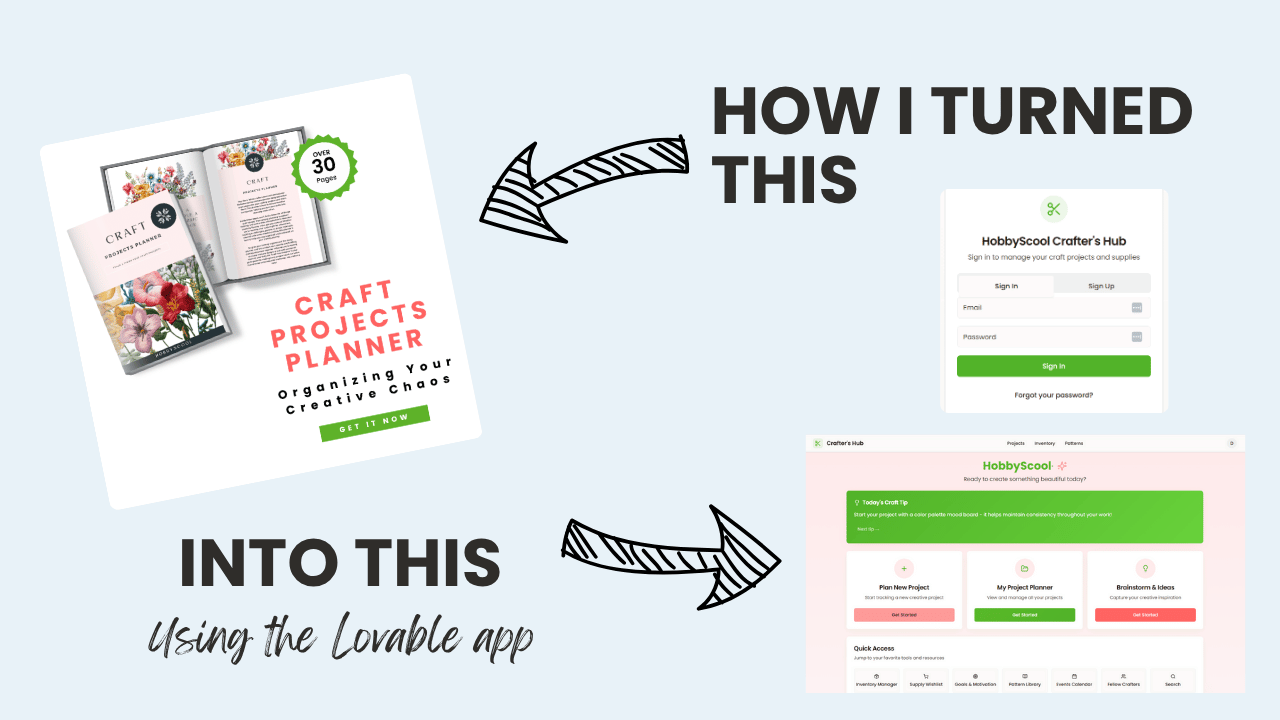
The HobbyScool Craft Projects Planner started as a printable. A practical companion for our Craft & Create Club members to brainstorm project ideas, set goals, and track what they were making.
Members loved it. It was also completely static, which turned out to be the whole problem. Once it's printed, a planner can't remind you about a deadline, tell you you're low on a supply, or nudge you about the quilt that's been half-finished since March.
So I asked what would happen if I turned it into something that could do all of that. What came out the other side was the HobbyScool Crafter's Hub, a working app I built myself, with no developer and no budget.
Why I bothered
Like most people running a membership, I was thinking constantly about differentiation. The Craft & Create Club already had workshops, planners, and monthly project ideas, and all of that is good. It's also what everybody else in the space has.
What I wanted was something that made members feel like they had a home base rather than a folder of downloads. Downloads get saved and forgotten. A place you return to is a different kind of relationship, and that difference shows up in whether people renew.
The planner was the obvious candidate because it was already the thing members used most. I wasn't inventing a new product, I was taking the popular one and giving it the ability to do things paper can't.
How I actually built it
I used Lovable, a no-code platform that turns a description into a working app. I'd heard about it through the usual creator grapevine and decided to test it on this.
The process was less technical than I expected. I uploaded the planner, described what I wanted the digital version to do, and the AI started generating the interface and the functionality. From there it was a conversation. I'd look at what it made, tell it what was wrong or missing, and it would adjust.
I built the whole thing solo, and I'm not a developer. That's the part I want to be clear about, because it's the reason most creators never try this. You don't need design skills or a technical background. You need to know what the thing should do and be willing to keep describing it until the output matches.
One constraint I set going in: it couldn't cost me anything ongoing. No paid API integrations, no third-party platforms with monthly fees attached. That ruled out a few fancier ideas and it was worth it, because a bonus that quietly costs you money every month is not a bonus.
"You already did the hard part when you made the content. Turning it into an app is just unlocking what's already there."
Dr. Destini CoppWhat the app does
The Crafter's Hub keeps everything the printable did and adds the things paper can't handle.
Inventory Tracking
Members log their supplies and get alerts when something is running low. This is the feature that gets mentioned most, because every crafter has bought a third roll of something they already owned two of.
Project Progress
It tracks what's in progress and keeps people moving on work they've started. Half-finished projects are the default state of this hobby, and a nudge at the right moment is worth more than another tutorial.
Event Integration
Upcoming HobbyScool summits and events show up inside the app, so members can plan projects around what's coming. This one quietly does marketing work, because the events are how the whole business grows.
Goals, Patterns, and Wishlists
Everything the printable did well: annual goals with things to check off, plus a pattern library, a wishlist, and supplier contacts all held in one place instead of scattered across notebooks and screenshots.
It ends up functioning like a craft room you can carry around, and because it's exclusive to annual and lifetime members, it gives monthly members a concrete reason to upgrade rather than a vague promise of more value.
The trap I'd tell you to avoid
Here's the part I care most about, because this is where I see creators get themselves into trouble.
Build the tool as an add-on to something educational. Do not make the tool itself the product.
The moment you sell software as your main offer, you are a software company. That means support tickets on Saturday morning, people emailing that it's not working on their phone, feature requests, outages, and an obligation that renews every month whether you feel like it or not. In a consumer market especially, the support load on a paid app is relentless, and none of it is the work you got into this to do.
The app raises the value of something I already sell. If it broke tomorrow, or if I retired it, the membership would still stand on its own. That's the test. If pulling the tool would gut the offer, the tool has quietly become the business.
Held that way, an app is genuinely great leverage. It makes an existing offer more valuable, it gives people a reason to move up a tier, and it costs you a weekend rather than a development budget.
What happened after this
The Crafter's Hub worked well enough that it changed how I think about every planner and spreadsheet we own.
The version of this that scaled wasn't more apps, though. It was pairing planners with AI assistants, selling the combination as a kit, and letting people paste prompts into the free version of ChatGPT or Claude instead of asking them to install anything. No API costs on my side, no accounts to manage, and the buyer gets something that behaves like a coach.
The data on that pairing surprised me. Across 2,864 VIP sales at one of our summits, checkout add-ons that combined a planner with an AI assistant attached at 42.4% and 36.3%, while single-workshop content add-ons at the same $9 price landed between 14.7% and 19.3%.
Same audience, same price, roughly double the take rate. The lesson I pulled from it is that people will pay for a tool that helps them do the thing, more readily than for more instruction about the thing. That's a useful thing to know before you decide what to build next.
If you want to try this
Start with the resource your audience already loves. Not a new idea, not the thing you've been meaning to make. The one they actually use, because you already have proof it's worth something to them.
Then ask what it can't do because it's static. Reminders, tracking over time, alerts, anything that requires knowing what happened yesterday. That list is your feature set, and it writes itself.
Then go describe it to an AI builder and keep iterating until it works. Budget an afternoon, expect it to take two, and don't try to make it perfect before you show anyone. Members will tell you what's missing faster than you'll figure it out alone.
The content is done. That was the hard part, and you finished it a long time ago.
Should You Build This, or Fix Something Else First?
A new tool only pays off if it lands in the right part of your business. Take the free Creator Business Scorecard to see which stage of your growth actually needs attention right now.
Take the Free Scorecard →Frequently Asked Questions
Use a no-code AI builder. Upload the printable, describe what you want it to do in plain language, and iterate with the AI until it works the way you pictured. The content already exists, which is the part that usually takes the longest, so the build is mostly a conversation about behavior rather than a design project.
Lovable is a no-code platform that turns a description or a document into a working web app. You tell its AI what you want, it generates the interface and the functionality, and you keep refining until you publish. No design or development background is required.
For most creators, include it. An app attached to a paid tier raises the value of something you already sell and gives people a reason to upgrade. Selling the tool on its own turns you into a software company, with support tickets, outages, and ongoing obligations that have nothing to do with teaching.
No. These tools are built for people who cannot code. What you do need is a clear picture of what the thing should do and the patience to keep describing it until the output matches. The constraint is clarity about the outcome, not technical skill.
That it stops being a bonus and becomes the product. Once people are paying for software, you owe them uptime, support, and updates indefinitely. Keep the app as an add-on to an educational offer, so that if it ever breaks or you retire it, the core thing you sell still stands on its own.