
266: What Dave Ramsey's Business Model Taught Me About Selling Digital Products

What does a personal finance media empire have to do with your digital product business?
More than you might think.
In this episode, I break down what studying Dave Ramsey's business model taught me about building a creator business that actually lasts. His staying power isn't about financial advice — it's about owning a framework and building an entire product ecosystem around it.
And the most durable digital product businesses I've seen do the exact same thing.
What You'll Learn:
The Ramsey business model breakdown
Ramsey's Baby Steps framework is the backbone of everything — his podcast, his books, Financial Peace University, his live events. One framework, packaged at every price point, serving the same customer at every stage of their journey. That's not just good marketing. That's a business model.
Why framework-driven businesses win
When you have a clear framework, your content makes more sense, your products connect, your marketing gets easier, and your audience sees you differently — not as someone who sells courses, but as someone who owns a system they want to be part of.
How a framework generates a full product ecosystem
Most digital product creators build products reactively — chasing trends, copying competitors, responding to requests. The result is a scattered product catalog that doesn't tell a coherent story. A framework fixes that. Each stage of your framework becomes a natural product opportunity, and your buyers can always see the next step.
The four questions to find your own framework
You probably already have a framework. You just haven't named it yet. I walk through four questions to help you excavate what's already there:
What is the transformation you help people achieve?
What are the stages someone moves through to get that result?
What do people get wrong about your topic — and how does your framework correct it?
What would you call it?
Why naming your framework matters
A named framework is a memorable framework. The Baby Steps. The Creator Growth Flywheel. The StoryBrand Framework. These names do real marketing work — they make your system feel like something people want to be part of, not just general advice they scroll past.
The One Question to Sit With:
Does your digital product business have a clear framework at its center?
If yes — are all your products and content mapping back to it, or have you drifted?
If not yet — use those four questions and start pulling from what's already there.
Connect With Destini:
What Dave Ramsey Taught Me About Building a Digital Product Business
Most digital product creators are building a collection of offers.
A course here. A template pack there. Maybe a membership they launched during a good month. Products that exist because the timing felt right, or a student asked for it, or a competitor was selling something similar.
The ones who build businesses that actually last are doing something different. They're not just building products. They're building around a framework.
I realized this while studying one of the most durable content businesses I've ever looked at closely. And it didn't come from inside the digital product space at all.
It came from Dave Ramsey.
What Dave Ramsey Actually Built
Dave Ramsey operates in the creator, expert, and media space — radio show, podcast, books, courses, live events, coaching. And most people assume his success comes from teaching personal finance.
But if you step back and look at the whole model, that's not quite right.
His business isn't built on financial advice. It's built on a framework.
Specifically, the Baby Steps. Seven steps. Clear progression. Each one leads naturally to the next. And that one framework is the backbone of his entire product ecosystem.
The Ramsey Product Ecosystem — One Framework, Every Price Point
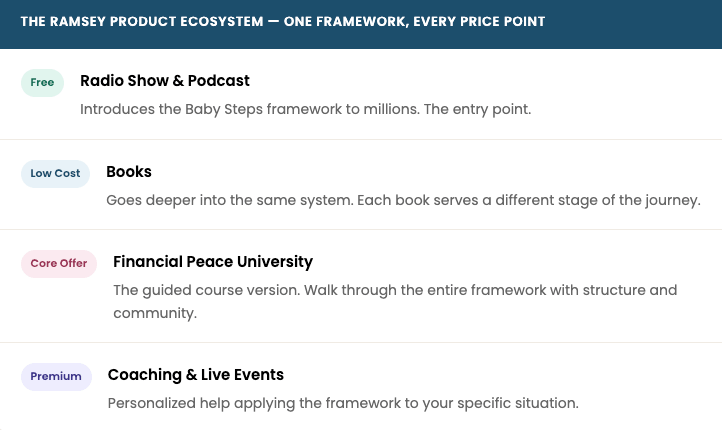
One framework. Packaged at every price point. Serving the same customer at every stage of their journey.
““That’s not just good marketing. That’s a business model.””
And here's what's also worth noting: this didn't happen overnight. Ramsey spent decades consistently reinforcing the same system. He didn't chase trends. He didn't pivot to new frameworks. He just kept going deeper on the one he already owned.
Every book. Every episode. Every event. All roads lead back to the Baby Steps.
That kind of consistency is what builds a brand that lasts. And it's something most digital product creators never quite achieve — not because they're not working hard enough, but because they don't have a central system to be consistent about.
The Question This Should Raise for You
When I sat with all of this, one question kept coming up:
Do I have a framework?
Not a niche. Not a content strategy. Not a list of tips.
A framework. A clear, repeatable system that organizes everything you teach — and that your audience can use to understand exactly where they are and what they need to do next.
Because here's what most online business owners miss:
The Key Insight
A framework isn't just a teaching tool. It's a business architecture tool.
When you have a clear framework, your content starts making more sense — because everything maps back to the same system. Your products start connecting — because each one serves a different stage. Your marketing gets easier — because instead of constantly creating new angles, you just keep teaching the same framework from different entry points.
And your audience starts to see you differently. Not as someone who sells courses, but as someone who owns a system they want to be part of.
That's a completely different positioning than most digital product creators have. And it's much harder to compete with.
What This Looks Like in Practice
Let me use my own business as an example, because I think it makes this more concrete.
The framework I've built everything around in my Creator's MBA portfolio is the Creator Growth Flywheel. Five stages: Attract, Engage, Nurture, Retain, Advocate.
It describes how digital product businesses actually grow. And more importantly, it gives my audience a way to see exactly where their business is breaking down.
Because of that framework, every piece of content I create maps to one of those stages. Every product I build solves a problem that lives inside one of those stages. And when someone comes into my world, they don't just buy a program — they start to see their whole business through the lens of the flywheel.
They start asking "which stage am I stuck in?" instead of "why isn't this working?"
That shift — from scattered frustration to a clear diagnostic — is what a framework creates. And it makes you indispensable in a way that a random product portfolio never can.
How a Framework Generates a Full Product Ecosystem
This is the part I really want you to sit with, because it's one of the most underappreciated benefits of building around a framework.
Most digital product creators build products reactively. Someone asks for something, you build it. A topic feels hot, you launch it. You see what a competitor is selling, you create your version. The result is usually a scattered product catalog that doesn't tell a coherent story.
Buyers can feel that. They don't know what to buy first. They don't know where one product ends and another begins. And there's no natural next step pulling them deeper into your world.
A framework fixes all of that.
When you have a clear system with distinct stages or steps, each stage becomes a natural product opportunity. Here's what that looks like in practice:
Your Framework-Driven Product Ladder
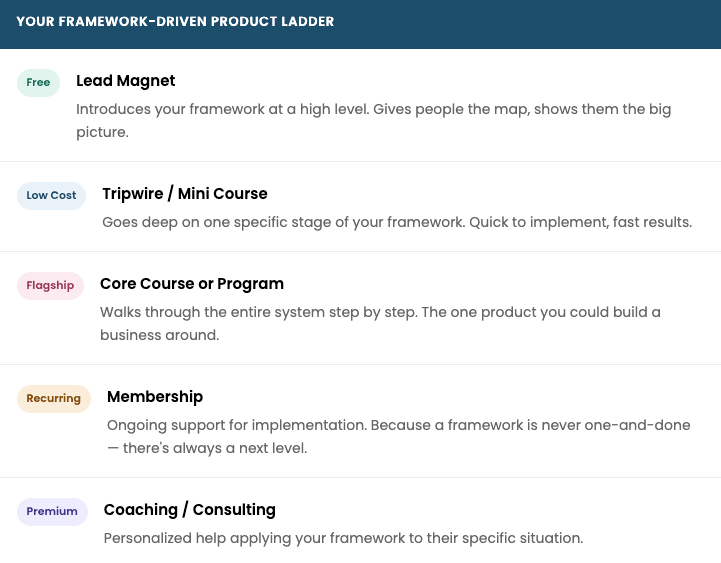
You're not guessing at what to build next. The framework tells you.
And because every product is connected to the same system, your buyers naturally want to go deeper. One purchase leads to the next — not because you're pushing them, but because the progression is logical. They can see the path.
That's what creates a real product ecosystem instead of a random product catalog.
How to Find Your Own Framework
I know some of you are reading this thinking: okay, I get it — I need a framework. But I have no idea what mine is.
Here's the reassurance I want to offer: most creators already have a framework. You just haven't named it yet.
It's embedded in how you work with clients. It shows up in the advice you give over and over again. It's the lens you can't help but see everything through.
So rather than trying to invent a framework from scratch, start by excavating the one you already have. These four questions will help:
What is the transformation you help people achieve?
Don't answer this with a topic. Answer it with a before and after. Before working with me, my audience is [stuck in this situation]. After working with me, they can [do this / feel this way]. That transformation is the spine of your framework — everything you teach should serve that before and after.
What are the stages or steps someone moves through to get that result?
Think about the people you've helped. What did they have to figure out first? What came second? What did they always get stuck on? There's usually a natural sequence — and that sequence is your framework. It might be three steps or seven, but the logical order is already there.
What do people get wrong about your topic, and how does your framework correct it?
This is where your framework gets a point of view. Ramsey's framework challenges the assumption that you should pay off your highest interest debt first. He says pay off the smallest debt first — because the psychological win matters more than the math. That's a controversial take, and it's a huge part of why his framework is memorable. What do you believe that most people get wrong? That belief is probably at the heart of your framework.
Can you name it?
A named framework is a memorable framework. The Baby Steps. The Creator Growth Flywheel. The StoryBrand Framework. These names do real marketing work — they make your system feel like something people want to be part of, not just general advice. You don't need the perfect name right away. But start thinking about it.
The Compounding Effect Nobody Talks About
Building around a framework isn't just a product strategy. It's a long-term brand strategy.
Every time you teach your framework, you reinforce it. Every piece of content that references it makes it more familiar. Every student who gets results from it becomes evidence that it works.
Over time, your name and your framework start to become synonymous. That's when the real compounding kicks in.
People don't just find you — they find your system. And they come to you specifically because they want to learn that system.
That's the kind of brand that doesn't depend on algorithms. It doesn't fall apart when a platform changes. It doesn't require you to constantly reinvent yourself — which I think matters more than ever in the AI-driven market we're operating in right now.
The framework is the business. Everything else — the content, the products, the community — is just different ways of serving people who want what your framework offers.
Dave Ramsey understood that. And it's why, decades later, his business is still growing.
The One Question to Sit With
Not a to-do list. Just one question worth taking seriously:
Your Action Item
Does your digital product business have a clear framework at its center?
If yes — are all your products and content mapping back to it? Or have you drifted?
If not yet — use the four questions above. Start excavating what's already there. Ask yourself: what's the transformation you create? What are the stages? What do you believe that most people get wrong? And what would you call it?
That's the work. And it might be the most important strategic work you do this year.
Pin this and save for later

Creator's MBA Podcast : What Dave Ramsey Taught Me About Building a Digital Product Business Transcript
Host: Dr. Destini Copp
Introduction
Hi there, Dr. Destini Copp here, and welcome back to the Creator’s MBA podcast. I’m super excited that you are joining me here today. This podcast is for digital product creators who want to build businesses that actually last — even in today’s AI-driven market.
Today I want to talk about something I’ve been studying lately that completely reframed how I think about building a digital product business. It started with a question I’ve been asking myself about brands that have been around for decades: what is it, exactly, that makes them stick?
Today we’re going to analyze someone in what I would define as the creator, expert, and media space — someone who’s been doing this for decades and built one of the most durable content businesses I have ever studied. And that person is Dave Ramsey.
What Dave Ramsey Actually Built
Most people think that Dave Ramsey’s success comes from teaching personal finance. But if you take a step back and look at the whole business model, you realize that’s not quite right. His business isn’t built on financial advice. It’s built on a framework.
Specifically, the Baby Steps. There are seven of them, there’s a clear progression between the steps, and each one leads to the next. And here’s what makes it so powerful for us to study: that one framework — the Baby Steps framework — is the backbone of his entire product ecosystem.
His radio show and his podcast introduce people to the Baby Steps for free. His books go deeper into that same system. Financial Peace University is the guided course version. And then he has coaching and live events that are his premium, personalized version. But it’s one framework, packaged at every price point, serving the same customer at every stage of their journey.
And that’s not just good marketing. That is a very strong business model.
What’s also very interesting is that it didn’t happen overnight. Ramsey spent years — really decades — consistently reinforcing that same system. He didn’t chase trends. He didn’t keep pivoting to new frameworks. He just kept going deeper on the one he already owned. Every book, every podcast episode, every live event — all roads lead back to the Baby Steps framework.
And that kind of consistency is what builds a brand that lasts. It’s something most digital product creators never quite achieve — not because they’re not working hard enough, but because they don’t have a central system to be consistent about.
The Question This Raises For You
When I really sat with this, one question kept coming up: do I have a framework? Not just a niche, not just a content strategy, not just a list of tips I’m teaching — a framework. A clear, repeatable system that organizes everything you teach, and that your audience can use to understand where they are and what they need to do next.
Because here’s the thing that most online business owners miss: a framework isn’t just a teaching tool. It’s a business architecture tool. And when you have a clear framework, something very interesting happens.
Your content starts making more sense, because everything maps back to that same system. Your products start connecting, because each one serves a different stage of the framework. Your audience starts to see you differently — not as someone who just sells courses or products, but as someone who owns a system they want to be part of. And then your marketing gets easier, because instead of constantly coming up with new angles, you just keep teaching the same framework from different entry points.
That’s a completely different positioning than most online business owners have, and it’s much harder to compete with.
What This Looks Like in Practice
I want to give you one of my own examples here, because I think this will make it a lot more concrete. The framework I have built everything around in my personal brand and my Creator’s MBA portfolio is the Creator Growth Flywheel framework. It has five stages: the Attract stage, the Engage stage, the Nurture stage, the Retain stage, and the Advocacy stage.
It describes how digital product businesses actually grow. And more importantly, it gives my audience a way to see exactly where their business is breaking down. Because of that framework, every piece of content I create maps back to one of those stages, and every product I build solves a problem that lives inside one of those stages.
And when someone comes into my world, they’re not just buying into a program. They start to see their whole business through the lens of the Creator Growth Flywheel. They start using that language. They start asking, “Which stage am I stuck in?” instead of wondering, “Why isn’t this working?”
That shift — from scattered frustration to a clear diagnostic — is what a framework creates. And it makes you indispensable in a way that a collection of courses or a course portfolio never can.
How a Framework Generates a Full Product Ecosystem
This is the part I really want you to sit with and think about, because I think it’s one of the most underappreciated benefits of building around a framework.
Most digital product creators build products reactively. Someone asks you for something, you build it. A topic feels hot in the market, you launch it. You see what a competitor is selling, you create your own version. And the result is usually a scattered product portfolio that doesn’t tell a coherent story. Buyers can feel that. They don’t know what to buy first. They don’t know where one product ends and another begins. And there’s no natural next step pulling them deeper into your world.
A framework fixes all of this. Because when you have a clear system with distinct stages or steps, each stage becomes a natural product opportunity. Think about it this way:
You could have a free lead magnet that introduces your framework at a high level — it gives people the map, it shows them the big picture. Then you have a low-cost product — maybe a tripwire-type offer, a mini course that goes deep on one specific stage of your framework, something people can implement quickly and see results from fast.
Then you have a core program or a membership that walks through the entire system step by step. That is your flagship. That is your signature offer. That’s the one product you could build a business around if you had to. And then a membership for people who want ongoing support as they implement, because a framework is never one-and-done — there’s always a next level, always a new layer to work through.
And then, if it fits your model, a coaching or consulting offer for people who want personalized help applying the framework to their specific situation.
In this scenario, you are not guessing at what to build next. Your framework tells you. And because every product is part of the same system, your buyers naturally want to go deeper. One purchase leads to the next — not because you’re pushing them, but because the progression is logical. They can see the path.
This is what creates a real product ecosystem instead of a random product catalog. And it’s exactly what Ramsey built. Every product he has exists to serve someone at a different stage of their Baby Steps journey. The framework created the roadmap. The products fill the roadmap.
How to Find Your Own Framework
Here’s where I want to get really practical with you, because I know some of you are listening and thinking, “Okay, Dr. Destini, I get it. I need a framework. But I have no idea what mine is.”
And I want to offer you some reassurance here: most creators already have a framework. You just haven’t named it yet. It’s embedded in how you work with clients. It shows up in the advice you give over and over again. It’s the thing you always come back to, the lens you can’t help but see everything through.
So rather than trying to invent a framework from scratch, I would encourage you to really dig into what you’re already doing and pull from that. Here are four questions that can help you do this.
Question #1: What is the transformation you help people achieve?
Don’t answer this with a topic. Answer it with a before and an after. For example: before working with me, my audience is stuck in a specific situation — whatever that situation is. And after working with me, they can do this specific thing or feel this specific way. That transformation is the spine of your framework, and everything your framework teaches should serve that before and after.
Question #2: What are the stages or steps someone moves through to get that result?
Think about the people you’ve helped through your courses, your coaching, your content. What did they have to figure out first? What came second? What was the thing they always got stuck on? There’s usually a natural sequence. It might be three steps, it might be five, it might be seven — like Dave Ramsey’s Baby Steps — but there’s almost always a logical order. And that order is your framework.
Question #3: What do people get wrong about your topic, and how does your framework correct it?
This is where your framework gets a point of view. Because a framework isn’t just a list of steps — it’s a way of seeing things. It challenges common assumptions. It reframes a problem. Ramsey’s framework challenges the assumption that you need to optimize everything financially. He tells people to pay off the smallest debt first, not the highest interest rate one, because the psychological win matters more than the math. That’s a point of view, and it’s a controversial one. But that controversy is part of what makes his framework memorable.
So think about: what’s the thing you believe about your topic that most people get wrong? That belief is probably at the heart of your framework.
Question #4: Can you name it?
This sounds simple, but it matters more than most people realize. A named framework is a memorable framework. It gives people something to attach to, something to share, something to search for. Dave Ramsey has the Baby Steps. I have the Creator Growth Flywheel. Donald Miller has the StoryBrand Framework. There’s another one called The One Thing. These names do real marketing work. They make the framework feel like something — a system, a method, an approach — rather than just general advice.
You don’t have to have the perfect name right away. But start thinking about it.
The Compounding Effect of a Framework-Driven Business
I want to close with one more thought, because I think it’s important. Building around a framework isn’t just a product strategy. It’s a long-term brand strategy.
Every time you teach your framework, you reinforce it. Every piece of content that references it makes it more familiar. Every student who gets results from it becomes evidence that it works. And over time, your name and your framework start to become synonymous. That’s when the real compounding kicks in.
People don’t just find you — they find your system. And they come to you specifically because they want to learn that system. That’s the kind of brand that doesn’t depend on algorithms. It doesn’t fall apart when a platform changes. It doesn’t require you to constantly reinvent yourself.
And I think that’s especially important in the world of AI that we’re living in right now. Because the framework is the business. Everything else — the content, the products, the community — is just different ways of serving people who want what your framework offers.
Dave Ramsey understood that. And I think that’s why, decades later, his business is still growing. The question is: what is your framework?
Closing
So that’s what I want to leave you with today. Not a to-do list — just one question worth sitting with seriously: does your digital product business have a clear framework at its center?
If yes — great. Now ask yourself: are all of your products and content actually mapping back to it, or have you drifted away from it over time?
If no — or “I’ve never really named it” — use those four questions I walked through and start pulling from what’s actually already there.
What’s the transformation you create? What are the stages someone moves through to get there? What do you believe that most people get wrong? And what would you call it?
That’s the work. And it might be the most important strategic work you do this year.
Thanks so much for listening today. If you have any questions about your framework — naming it, building the steps, or figuring out where to start — shoot me an email. All the links will be in the show notes. Have a great rest of your day. Bye for now.
Thanks for listening all the way to the end. If you love the show, I’d appreciate a review on Apple Podcasts or your favorite podcast platform. Have a great rest of your day — bye for now.