
256: Why I’m Documenting Decisions, Not Outcomes, as I Grow HobbyScool
We often hear about success after it happens, but what if the real learning is in the decisions, not just the outcomes?
In this episode of the Creator’s MBA podcast, I share the real reason behind the $1 million HobbyScool experiment—and it’s probably not what you think. This isn’t about a dramatic pivot or fixing something broken. HobbyScool was working. The experiment started because I realized that, as my business grew, what I needed most wasn’t more case studies or strategies, it was clarity around how decisions are actually made when the outcome isn’t obvious.
This episode is a transparent look at why I’m documenting the thinking, the trade-offs, and the context behind every key decision, not just the highlight reel. If you're beyond the beginner stage and craving more nuanced, in-the-moment insight, this is for you.
What You’ll Learn:
Why I shifted focus from outcomes to real-time decision-making
The hidden cost of polished success stories and post-mortems
What decisions actually look like when the outcome isn’t clear
Why real growth comes from decision patterns—not one big move
How I’m documenting uncertainty to sharpen judgment (yours and mine)
The backstory behind a 17,958-attendee creative event and what really happened behind the scenes
How to access my free “Decisions Breakdown” report
If you've ever read a case study and still wondered how they actually decided that, this episode will feel like a breath of fresh air. Listen in and grab the free report linked in the show notes to see the real decisions behind the scenes.
Mentioned in this episode:
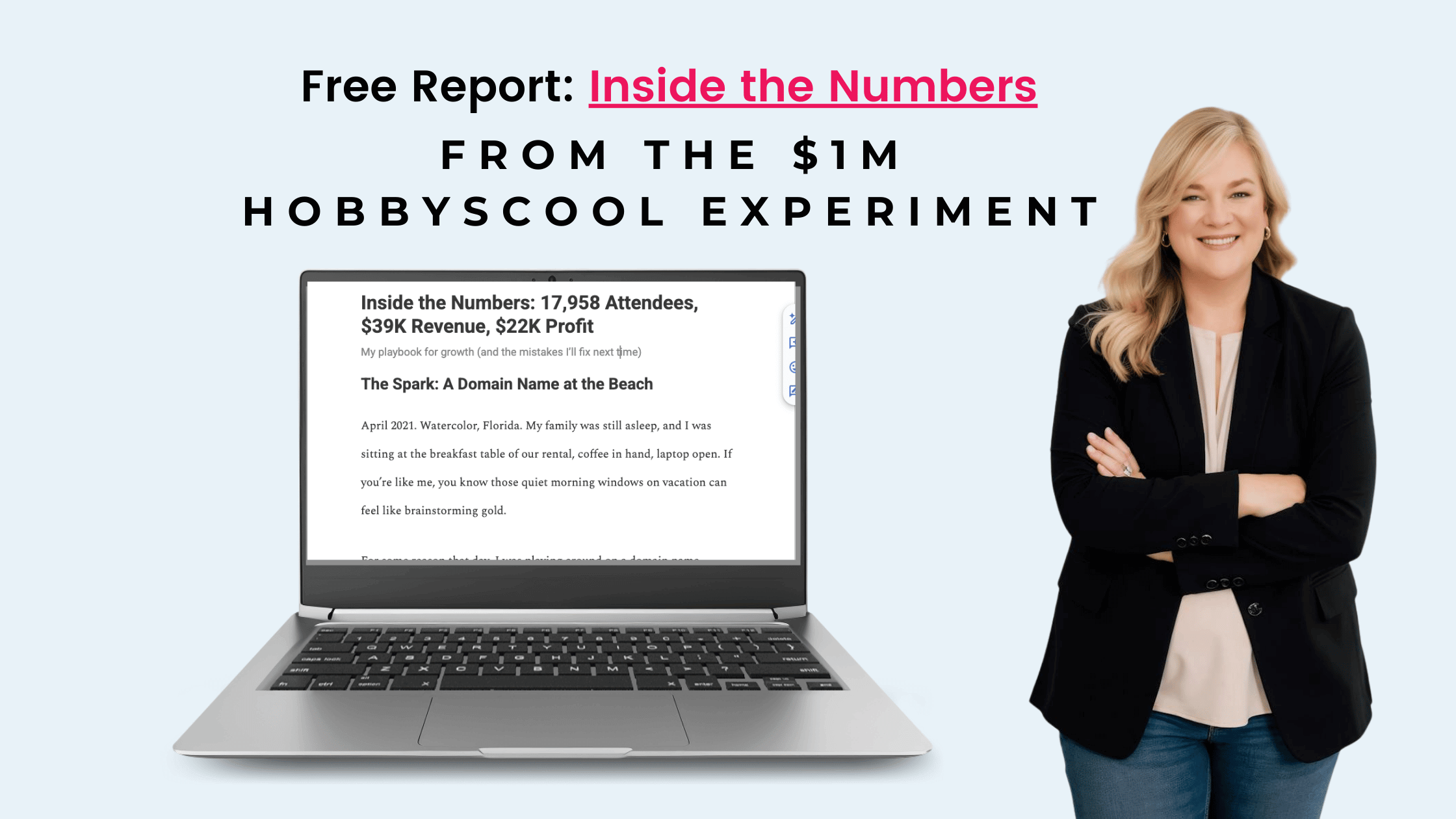
Free Report: The Decisions Behind a 17,958-Attendee Creative Event
What No One Tells You About How Big Business Decisions Really Get Made
We’ve all seen the polished case studies. The revenue screenshots. The “how I did it” stories after the win. But here’s the thing: those outcomes, while impressive, rarely tell the whole story. They tell you what happened—but not how the decisions were made to get there. And that’s the gap I’m filling with the $1 million HobbyScool experiment.
This experiment didn’t begin because something broke. HobbyScool was working. The events were successful, people were showing up, revenue was coming in, and our audience was growing. From the outside, it looked exactly like what you’d want in a thriving business. But I kept feeling this internal nudge: the conversations I was having and the content I was consuming were all centered around results. And honestly? That just wasn’t cutting it anymore.
When Advice Stops Being Useful
Early in your business, advice is gold. You want direction, reassurance, proven paths. But as your business matures, the questions shift. You’re no longer asking, “What should I do?” Instead, you’re asking, “What deserves my focus right now?” “What should I double down on?” “What do I walk away from—even if it’s working?”
Those questions don’t come with cookie-cutter answers. They depend on your context, your timing, your constraints. And they involve trade-offs that almost never show up in a tidy revenue breakdown. That’s why, for me, simply hearing what worked for someone else felt increasingly hollow. I wanted to know what they considered, what they ruled out, what they almost chose—and why.
The Missing Piece in Most Success Stories
Most business success stories are retroactive. You only hear about the decision once it’s worked. The uncertainty is gone. The mess has been cleaned up. It’s edited and packaged in a way that makes it feel inevitable. But that’s not how decisions actually unfold in real time.
Real decisions happen when multiple paths look reasonable. When you don’t know if it’ll work. When you’re weighing trade-offs between two “good” options, not a clear right vs. wrong. That’s the part I realized no one gets to see—and that’s exactly what I want to share through the HobbyScool experiment.
One Real Decision: The 17,958-Attendee Event
Let me give you a real-world example. We hosted a creative event that brought in 17,958 attendees. From the outside, it looked like a slam dunk. But behind the scenes? Dozens of decisions were being made—about partnerships, traffic channels, monetization, and more. Some things went beautifully. Some things leaked revenue. And many decisions were made with incomplete information.
I broke all of that down in a free report: The Decisions Behind a 17,958-Attendee Creative Event. It’s not a blueprint or a checklist, and it’s definitely not a promise of replicating results. It’s a real-time breakdown of what I was evaluating, why I went one way over another, and where I’d do things differently next time. If you’ve ever finished reading a case study and thought, “But how did they decide that?”—this is for you.
Why I’m Building in Public (and Why It Matters)
I’m documenting these decisions for one core reason: because businesses don’t grow from one big move. They grow from a pattern of decisions made consistently over time. That’s what this experiment is all about. Not the glossy version. Not the after-the-fact success story. But the actual decisions—shared while the uncertainty is still there.
When you understand how decisions are made, you don’t need nearly as much advice. You can think more clearly. Judge more wisely. And that’s what I want for every creator and digital product entrepreneur out there.
If You’re Ready to See the Behind-the-Scenes…
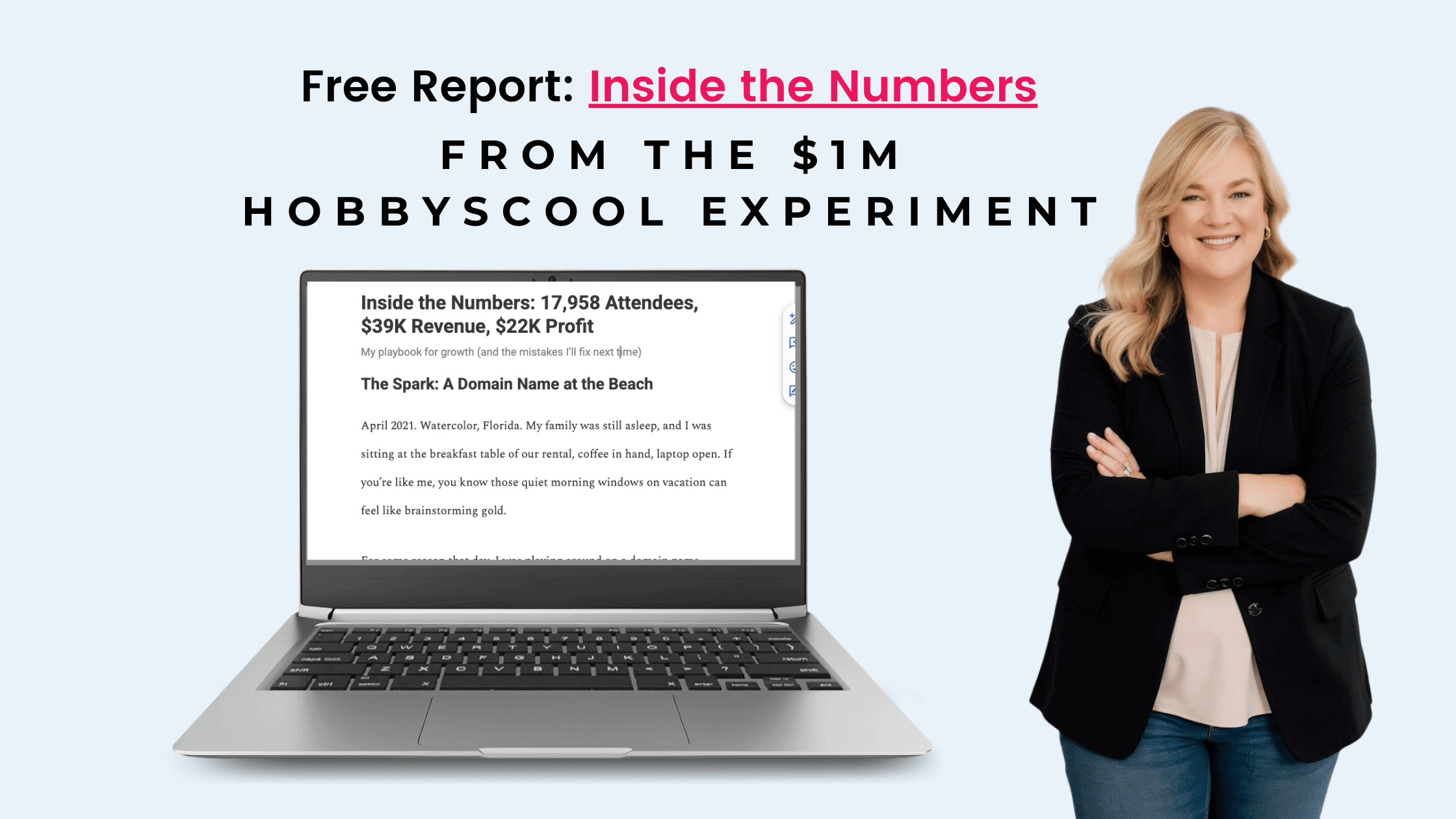
Start with the free report. It’s the first documented decision in the HobbyScool experiment, and it’ll give you a taste of what’s coming next. If following along as these decisions compound over time sounds valuable to you, then you’ll understand what this experiment is really about.
Because the truth is: clarity doesn’t come from knowing the outcome—it comes from understanding the choices that led there.
Pin this and save for later
Transcript
[00:00:00] Welcome to the Creator's MBA podcast, your go-to resource for mastering the art and science of digital product entrepreneurship. My name is Dr. Destini Copp, and I help business owners generate consistent revenue from their digital product business without the need to be glued to their desk, constantly live launching, or worrying about the social media algorithms.
I hope you enjoy our episode today.
Hi there, Destini here, and welcome back to the Creator's MBA podcast. I am super excited that you are joining me here today, and I want to start by clearing something up because I think this matters for how you hear the rest of this episode. Okay. The $1 million HobbyScool experiment did not start because something went wrong.
[00:01:00] There wasn't a breakdown, a burnout moment, or some dramatic pivot. HobbyScool was working. We were running events, people were showing up, sales were coming in, and the audience was growing. If you looked at it from the outside, it looked exactly like a business doing what it is supposed to do. What caught my attention wasn't a problem.
It was a gap that I had. As the business grew, I kept noticing that almost every conversation was about growth-focused outcomes: revenue, numbers, audience size, what worked, what didn't. And the more experience I gained, the less helpful those conversations felt to me. Not because outcomes don't matter. They absolutely do. But because outcomes can be the least useful part of the story once you are past the beginner stage. They tell you what happened, but they don't tell you how the decision was actually made.
[00:02:00] They also don't show you what was considered, what was ruled out, or what almost happened instead. And that's the part that actually helps you make better decisions in your own business.
And when you're early on, advice is useful. You're looking for direction and reassurance. But when your business is already working, the questions change. You're not asking, what should I do? You're asking, what do I decide? What deserves my focus right now? What do I double down on? What do I leave alone or quit, even if it's working?
[00:03:00] Those questions don't have universal answers. They're contextual. They depend on timing, systems, constraints that you have, trade-offs that rarely show up in polished case studies. What most people get to see are the decisions after they've worked. Once that uncertainty is gone, once the story makes sense, once everything has been cleaned up for presentation. And that's not how decisions are actually made. Real decisions happen when multiple paths look reasonable, when the outcome isn't clear yet, and when you are choosing between trade-offs, not right versus wrong.
[00:04:00] And that's the part I realized almost no one gets to see. So the $1 million HobbyScool experiment exists for one simple reason: to document real business decisions as they are being made. Not after they succeed. Not once I have a really cool lesson to teach. I want to document it while the uncertainty is still there—what I'm considering, what I'm ruling out, and why one option wins over another.
Not so that people can copy the decision, but so you can see how decisions are evaluated. Because once you understand how decisions are made, you don't need nearly as much advice.
[00:05:00] And I want to give you a concrete example. One of the times that I did this was around a large creative event that we ran that brought in around 17,958 attendees. And from the outside, it looks like that was a straightforward success. But on the inside of the event, there were dozens of decisions about collaborations, traffic platforms, monetization, and trade-offs. And that doesn't show up in a recap post or a revenue screenshot.
So I broke down that moment in a free report that I call The Decisions Behind a 17,958-Attendee Creative Event, and I want to be very clear on what this report is and what it isn't. It's not a blueprint. It's not a checklist. And it is definitely not a promise that you will get the same result. It's one real decision breakdown. I walked through what I was deciding in real time, why certain choices were made, where money showed up, where it leaked, and what I would do differently next time.
[00:06:00] And if you have ever read a case study and thought, okay, but I still don't know how they decided that, this report is meant to answer that question. And you can grab it for free through the link in the show notes.
And zooming back out for a second, the reason why I'm doing this experiment publicly is very simple. Businesses don't grow because of one smart move. They grow because of a pattern of decisions made over time. And the $1 million HobbyScool experiment exists to document that pattern as it unfolds. It's not a polished report. It's not, "I went through and made all of these adjustments." It's just real decisions shared honestly.
[00:07:00] And if seeing one concrete decision breakdown feels helpful to you, I want you to start with the free report. And if following along as those decisions compound over time sounds valuable, you'll understand what this experiment is really about. And in the next episode, I'm going to talk about what changes when you start to look at decisions this way and why seeing decisions in motion will sharpen your judgment in a way advice never can.
Thanks for listening and I'll see you in the next episode. Bye for now.
[00:08:00] Thanks for listening all the way to the end. I hope you enjoyed this episode today. If you love the show, I'd appreciate a review on Apple Podcasts or your favorite podcast platform. Have a great rest of your day, and bye for now.