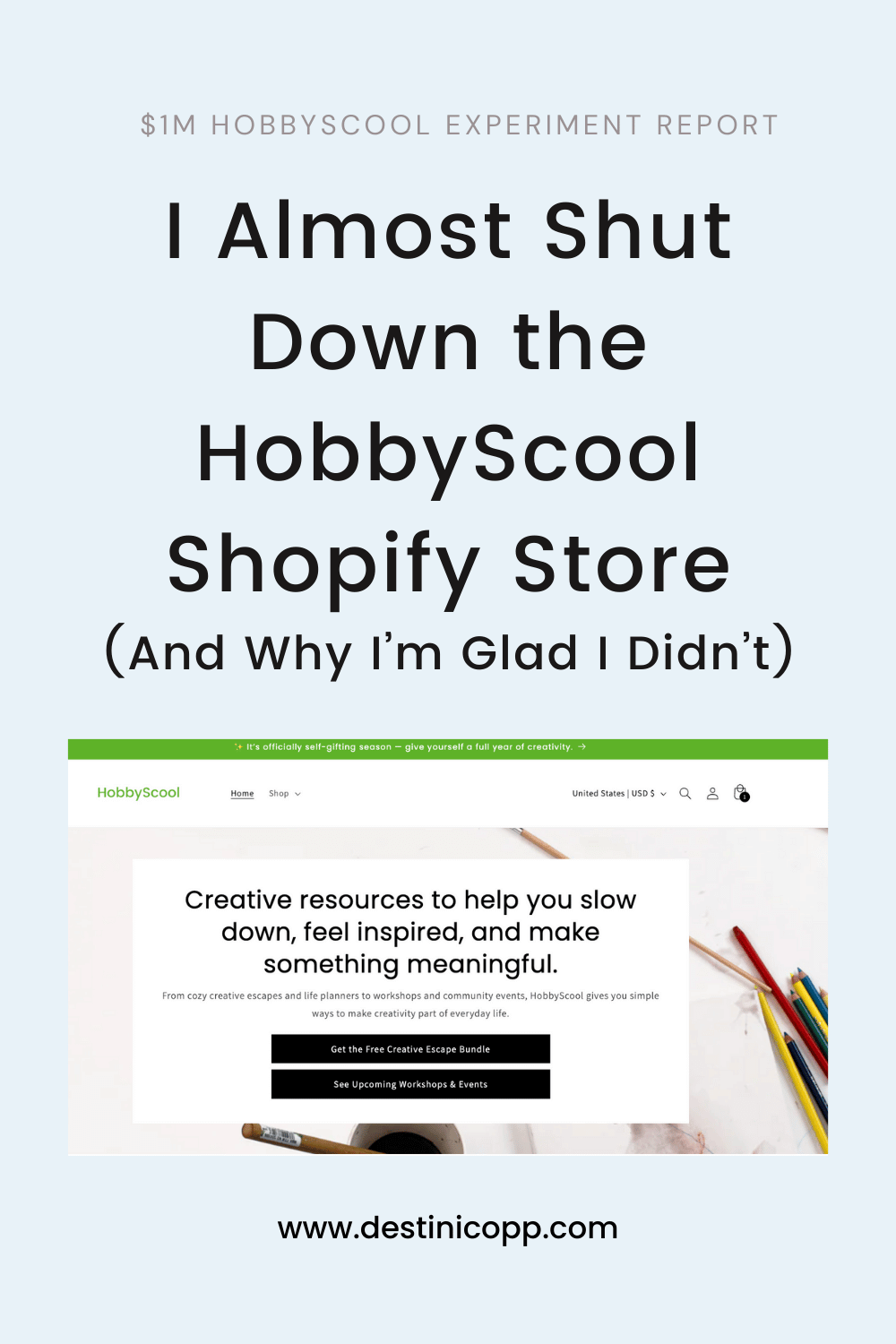


For a long time, the HobbyScool Shopify store felt optional.
It wasn't broken and it wasn't losing money. It also wasn't something I thought about very often. If I'm being honest, it lived in that familiar category of nice to have, which meant a little extra revenue, a few low-priced products, and somewhere to park VIP passes.
At one point I seriously considered shutting it down. Not because it failed, but because time is always the constraint, and anything that isn't clearly pulling its weight eventually becomes a question mark.
What changed my mind wasn't a big optimization project or a traffic spike. It was one week where I treated the store like a real part of the business instead of a background system, and that exposed something I'd been getting wrong.
Why It Drifted Into "Nice to Have"
Here's how something ends up in that category, and it's rarely dramatic.
The store sells small things. Journals and coloring books in the $5 to $9 range, a tracker or two, the annual workshop pass. Nothing there is going to show up as a line item that changes my month, so when I looked at where my attention should go, the store never won.
Meanwhile the summits were obviously important, the membership was obviously important, and the email list was obviously important. The store just sat there quietly doing its thing, which is exactly the profile of something you eventually decide to shut off.
What I was doing was judging it by the revenue it generated on its own. That's the mistake, and it's an easy one, because that's the only number that shows up on a dashboard.
"I was judging the store by what it earned on its own. The right question was what else stops working if I turn it off."
Dr. Destini Copp, Creator's MBAWhat Running a Real Promo Revealed
The thing that shifted my thinking was running an actual promotion through the store instead of letting it sit there.
When you promote something, you have to look at it properly. And what I saw was that the store wasn't a side revenue stream at all. It's where the products live that everything else depends on.
The order bump inside my summit funnel is a store product. The upsells point at store products. The annual pass sells through the store. So when I imagined shutting it down, I wasn't imagining losing a few hundred dollars a month in journal sales. I was imagining pulling the catalog out from under a funnel that runs every single month.
That's the difference between a revenue stream and infrastructure. One of them shows you what it's worth. The other one only shows you when it's gone.
Why I Decided Not to Optimize It Yet
Here's the part that surprised people when I talked about it. After deciding to keep the store, I didn't optimize anything.
No conversion work, no new product line, no redesign. Because the decision I'd just made was about whether the store belonged in the business at all, and that's a different question from how to make it perform better.
Optimizing something before you've decided its role is how you spend a month improving a thing you were going to shut down anyway. Decide what it's for first. The work comes after, when you actually know what you're building toward.
Keep or cut. Then what it's for. Then how to make it better. Most of us start at the third question and wonder why the effort doesn't stick.
Thinking Like a Buyer Changed the Decision
The thing that settled it was looking at the store the way someone buying the business would look at it.
I'm building HobbyScool to be sold, and that changes what counts. A buyer isn't evaluating my monthly journal revenue. They're looking at what transfers to them, which means the product catalog, the customer records, the sales history, and whether the whole thing can be handed over cleanly without me attached to it.
The store is one of the cleanest assets in that business. It has its own product records, its own order history, its own policies, and it now sits under its own entity. It's the kind of thing that makes a business look like a business rather than a collection of things one person was running.
Once I looked at it through that lens, shutting it down went from a reasonable simplification to an obviously bad idea. I'd have been deleting an asset to save a small amount of attention.
How to Check Your Own "Nice to Have" Assets
You probably have one of these. Something that isn't broken and isn't growing and quietly sits at the bottom of your priority list. Before you cut it, run it through these four questions.
What Breaks If This Disappears Tomorrow?
Trace what depends on it, not what it earns. If a funnel, a delivery process, or an offer you actively sell runs through it, the revenue on its own line is telling you almost nothing about what it's worth.
Would It Transfer to Someone Else?
Ask whether a buyer, a partner, or a new team member could take it over as-is. Things that transfer are assets, and things that only work because you're the one running them are jobs you gave yourself.
Is It Actually Costing You Anything?
Be specific about the cost, because most of the time the honest answer is a small monthly fee and a bit of mental overhead. That's a very different situation from something eating hours every week, and the two deserve different decisions.
What Would It Take to Rebuild It Later?
Some things you can turn off and turn back on. Others take a catalog, a history, and years of accumulated customer data that you can't recreate on demand. Anything in the second group deserves a much higher bar before you cut it.
What This Is Really About
None of this is a story about Shopify. It's about how you decide what's worth building when your time is genuinely limited, which is the position most of us are in permanently.
Nice-to-have assets quietly turn into deal-breakers, and the choices that look optional now are the ones that determine what your business is worth later. Thinking like a buyer instead of only like an operator changes what you keep, what you cut, and what you commit to.
Which is a decision worth getting right before it's obvious, because by the time it's obvious you've usually already made it.
Which Part of Your Business Is Actually Carrying It?
The free Creator Business Scorecard walks your five growth systems and shows you which one is doing the most work and which one is quietly holding everything back.
Take the Free Scorecard →Frequently Asked Questions
Don't judge it by the revenue it produces on its own. Ask what else stops working if you remove it. Something that earns very little but supports your funnel, your delivery, or your ability to sell the business later is worth more than its own sales line suggests.
An asset holds value independently of you. It has its own catalog, its own customer records, its own history, and it could be handed to someone else without falling apart. A side project usually lives in your head and stops the moment you stop paying attention to it.
Because a store gives you somewhere to put the small products that support your bigger ones. Order bumps, low-priced add-ons, and physical or printable extras all need a home with real product records and checkout behind them, and building that once beats rebuilding it inside every funnel.
Usually the opposite. Decide whether it's worth keeping first, then leave it alone until you know what it's for. Optimizing something before you've decided its role is how creators spend a month improving a thing they were going to shut down anyway.
A buyer values what transfers. Clean entity ownership, a catalog and customer list that come with the business, and systems that don't require you to keep running them. Once you look at your business that way, some things you considered optional become the parts worth protecting.