
Why SMS Is the Missing Piece in Your Newsletter and Digital Product Strategy

Most digital product creators and newsletter operators are leaving money on the table, and it usually has nothing to do with the content or the offer. It's that they only show up in one place.
Your email list is your most valuable asset. You've heard that a thousand times and it's still true. But there's a second channel sitting right next to it, one that gets around 12% click rates compared to email's 2 to 3%, and most creators aren't touching it.
That channel is SMS. If you're building a newsletter business or selling digital products, it might be the most underused growth tool in your whole stack.
So let me walk you through how to think about it, how to use it, and how to layer it into what you're already doing without starting over or adding a pile of complexity.
Why This Works
Email is your digital living room. You've invited your readers in, they've given you their attention, and that relationship builds over time. It's where you tell the bigger stories, build the habit, and move people through your products.
SMS is a direct line to somebody's inner circle. It's the channel people check the second it buzzes, and it's where they talk to family, close friends, and the very short list of brands they actually trust. Getting in there is harder, and that's exactly why it's worth something when you do.
The data holds up too. When creators run email and SMS together, click rates can come in up to 97% higher than email alone. Not instead of email. On top of it.
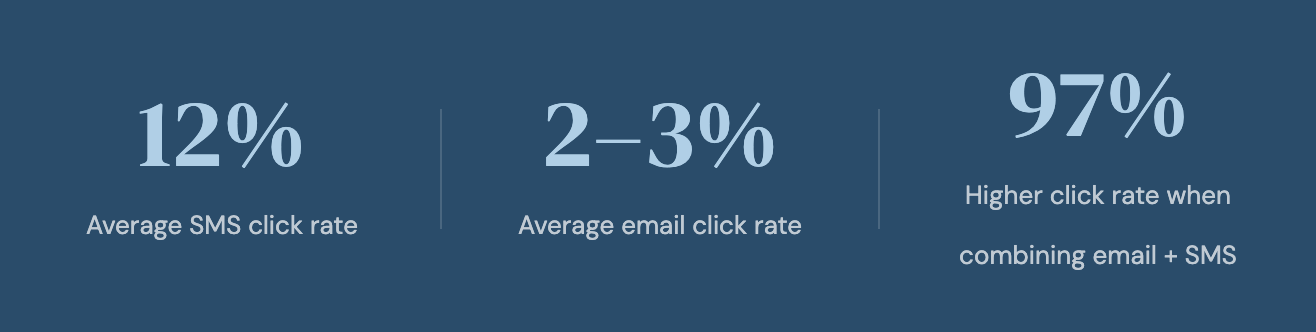
That's not a rounding error. That's a lift big enough to change your revenue, especially if you sell digital products with real launch windows or run a membership where retention is the whole game.
The Mindset Shift to Make First
Almost everyone who tries SMS makes the same mistake. They treat it like a shorter version of their email.
That's not what it is. SMS isn't for your regular newsletter content, your weekly roundup, or your long teaching moments. It's for the moments that need action right now.
"Every text you send should feel like it matters. Send too many and you train your list to ignore you."
Dr. Destini Copp, Creator's MBAFour Ways to Use SMS in Your Creator Business
Editorial Moments That Actually Matter
Most of us aren't running a breaking news desk, but there are still moments when something needs to hit fast. You're dropping a new free resource and you want your most engaged readers to see it first. Something big shifted in your niche and you want to be the first voice they hear it from. Your live workshop starts in 10 minutes. The creators who do this well save texts for the moments that earn the interruption, so when a text does come through, people look.
Marketing Your Products and Offers
You're already sending five to seven emails when you launch something. SMS doesn't replace that sequence, it amplifies it. Picture the reader who opens every launch email and never buys. They're clearly interested, but something is holding them there. A text that lands right before the cart closes is often the nudge that moves them. Events work the same way, because "we start in 15 minutes, here's the link" hits differently by text than by email.
Selling Digital Products
If you sell courses, templates, prompt packs, or swipe files, SMS compresses the sales cycle. Flash sales land harder by text, because that urgency is hard to fake anywhere else. Abandoned cart recovery works well too, since someone who made it to checkout is a warm lead who just needs a friendly reminder. And post-purchase is an underrated one, because a text right after someone buys is the fastest way to get them into the community or watching the right first video.
Retaining Members and Cutting Churn
This one matters most if you run a membership. People leave because they lost engagement, or because life got busy, and surprisingly often because a credit card expired, the payment failed, and nobody followed up fast enough for them to bother fixing it. A text the day a payment fails with a link to update the card recovers a real chunk of that. Renewal reminders work the same way, because a warm heads-up keeps people from churning purely because they forgot they were subscribed.
How to Layer SMS Into What You Already Have
You don't need to rebuild your strategy. You need to add a layer on top of it. Here's how I'd approach it.
Start with one use case
Don't try to do everything at once. Pick the one with the highest return for your business right now. If you're actively launching products, start there. If churn is your real problem, start with payment recovery and renewal reminders. Prove one thing works, then expand.
Build it into your welcome sequence
When someone joins your list or buys a product, that's the best moment to ask for a phone number. Keep the field optional so it isn't a barrier, and tell them exactly what they're opting into, something like "I'll text you when I'm launching something new." Being clear about it is what builds the trust.
Use email to grow your SMS list
This one is badly underused. Mention your text list in your regular newsletter. After someone buys, send an email that says "want updates faster? join my text list." And if you reserve SMS for paid members, make a real moment out of it when someone joins.
Let the channels do different jobs
Email carries depth, habit, and storytelling. SMS carries urgency and action. Once each channel has a clear job, they stop competing and start compounding.
A Simple SMS and Email Framework for a Launch
Here's how the two channels fit together across a product launch.
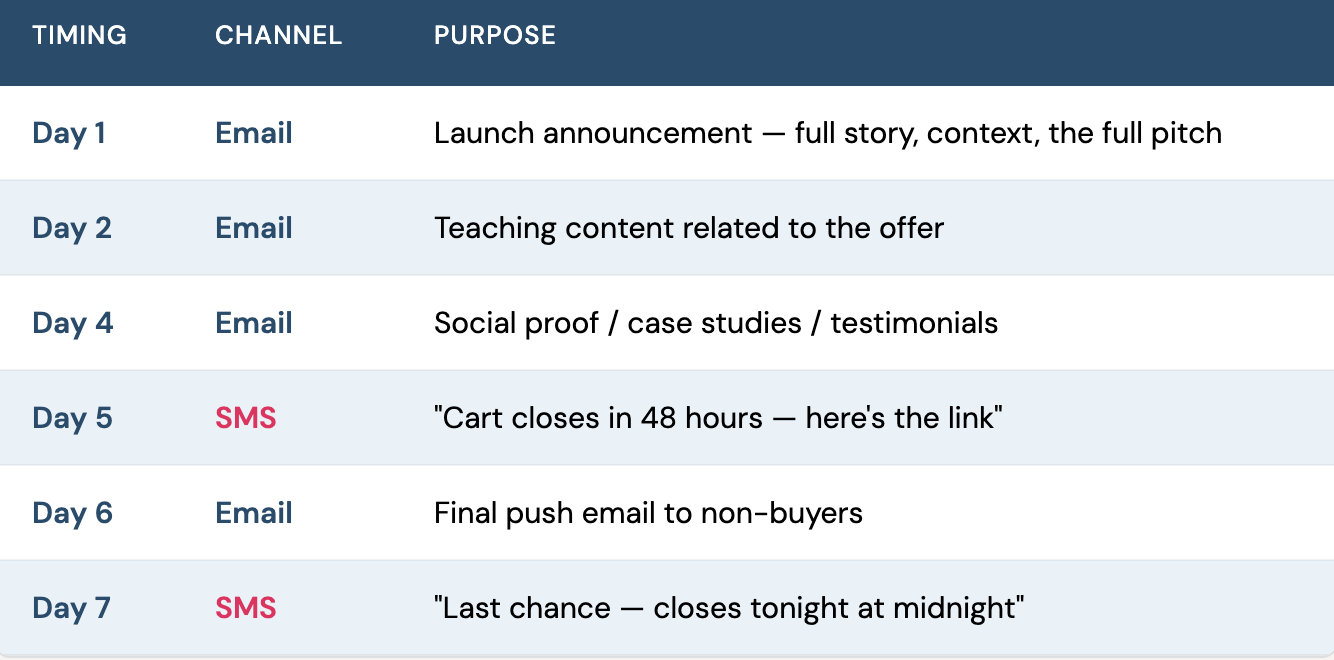
Notice that SMS only shows up twice, at the urgency milestone and at the final close. That's on purpose. Every text should feel like it matters, and the fastest way to ruin the channel is to use it for things email could have handled.
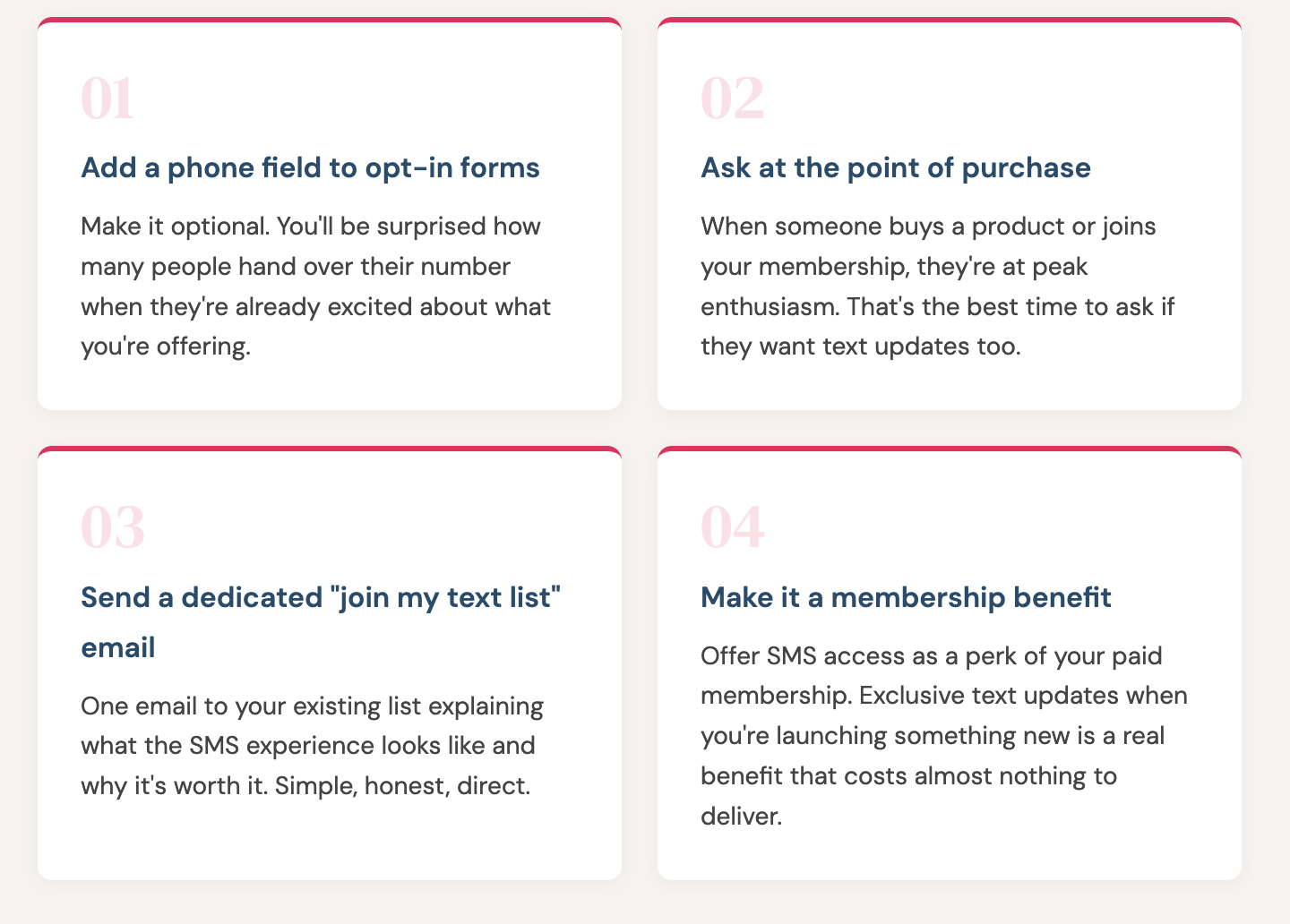
How to Grow Your SMS List Without Starting From Scratch
You don't build this list separately. Your email list is the growth engine for it.
A Few Things to Know Before You Start
Pricing runs on credits, not list size
Email platforms charge you per subscriber. SMS platforms usually charge credits per message, where a short message under 153 characters costs one credit and longer messages, emojis, or images cost more. Know your pricing before you scale, because the math is different from what you're used to.
Measure what actually matters
Skip open rates for SMS, because that number is unreliable and often just measures delivery. Track clicks, replies, and revenue instead. Those three tell you whether the channel is doing anything for you.
Don't be a spammer
SMS is an incredibly personal channel, and the moment you over-send or send things people didn't ask for, the trust is gone. You're not trying to win one click today. You're trying to keep your spot in someone's phone for years. Send less than you think you should and make every message count.
Compliance matters
Get explicit opt-in consent, only send the types of messages people signed up for, and always include an easy way out, which means replying STOP has to work every time. Use a reputable platform that handles the compliance infrastructure for you.
If you wouldn't be a little glad to receive the text yourself, don't send it.
The Bottom Line
If you run a newsletter, sell digital products, or operate a membership, SMS stopped being a someday channel. The creators who build even a modest text list and use it with restraint are going to have a real edge on engagement and conversions over the ones who wait.
You don't need a huge list for this to work. You need one clear use case, a simple way to collect phone numbers, and the discipline to only send when it actually matters.
Start small, measure everything, and build from there. This is exactly the kind of multi-channel work we do inside Newsletter Profit Club, where we layer revenue streams and turn a newsletter into an actual business.
You don't have a content problem. You have a structure problem.
Get the three-part newsletter structure from my six-month study of 36 newsletters, including the Mini Magazine format and the Teach and Pitch Method.
Watch the free training →Frequently asked.
Do I need a big email list before SMS makes sense?
No. You need an engaged list, not a massive one. Even 100 to 200 SMS subscribers who opted in on purpose will outperform a bloated list of people who gave you their number by accident. Start collecting numbers now and build the habit of sending well.
What SMS platform should I use?
It depends on your stack. Mailchimp has SMS built in, which keeps email and texts in one place for segmentation and automation. Klaviyo is strong if you're on Shopify, and SimpleTexting and Attentive are both solid. The main thing is using a reputable sender that handles compliance for you rather than a workaround or your personal phone.
Can I use my Kit account for SMS?
Kit is email only, so you'll need a separate SMS platform. Most SMS tools connect to Kit through Zapier, so you can tag subscribers in Kit based on SMS opt-ins, trigger texts from Kit sequences, and keep your segmentation lined up across both.
How often should I text my list?
Less than you think. For most creators, 2 to 4 texts a month is a solid ceiling, and even that is a lot if the messages aren't worth reading. A good gut check is whether you'd be a little glad to get this text yourself. If not, don't send it.
What's a realistic SMS list size to aim for?
There's no magic number, but 10 to 20% of your email list is a useful first target. If you have 2,000 email subscribers, 200 to 400 SMS subscribers is realistic in year one. After that, every 100 you add is a direct revenue channel for launches and offers.
Do I need separate SMS consent, or does my email opt-in cover it?
You need explicit, separate consent for SMS. An email opt-in does not cover text messages. When you collect a phone number, say exactly what people are signing up for, like occasional launch alerts or time-sensitive updates. Burying it in a general terms checkbox is not enough and creates compliance problems later.
How do I handle SMS for a global audience?
International SMS gets complicated fast. Non-US numbers cost more credits, sometimes a lot more, delivery rates vary, and compliance rules differ by country. If your audience is mostly US-based, don't let this stop you. If you have a big international segment, start US-only and expand once you've tested the channel.
Is it too early to add SMS if my email list is small?
It's a great time to start, because you can build both lists at once from the beginning. Ask every new subscriber, buyer, and event registrant for a phone number alongside the email. Starting small costs you almost nothing, and waiting until you're big enough costs you two years of list growth.
What should my first SMS campaign say?
Keep it simple and action-oriented. Something like: "Hey [Name], [Your Name] here. Thanks for joining. Watch for texts when I'm dropping something new or time-sensitive. Reply anytime, I actually read these." That sets the tone as personal, low-frequency, and two-way. After that, only text when you have a real reason.
How do I measure whether SMS is actually working?
Track clicks, replies, and revenue from SMS sends. Most platforms show link clicks natively, replies tell you how alive the channel is, and revenue takes UTM parameters on your links plus conversion tracking in your checkout. Skip open rates, because that number is unreliable for SMS and usually just measures delivery.

Dr. Destini Copp helps digital product creators build sustainable, systems-based businesses through the Creator Growth Flywheel framework. She's the founder of Creator's MBA and HobbyScool, and has been teaching online business strategy for over a decade. Learn more →